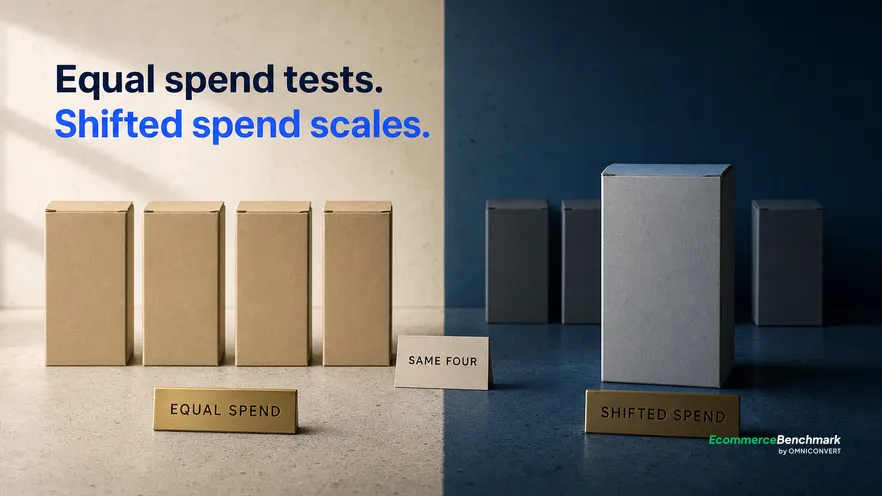
ABO vs CBO is not a contest between a worse structure and a better one. ABO puts the budget on each ad set, guaranteeing every ad set its own spend, which is what makes a creative or audience test readable. CBO puts one budget on the campaign and lets Meta move it toward whatever looks cheapest right now, which is what makes proven winners efficient. Use ABO where the campaign exists to produce an answer, and CBO where it exists to spend against answers you already have. Most strong accounts run both, permanently, for those two different jobs.
- ABO guarantees spend per ad set; CBO optimises spend across them. That is the whole mechanical difference.
- CBO reallocates on early signal, so it answers which ad started fastest, not which ad is best.
- Run a permanent ABO testing campaign alongside CBO scaling campaigns rather than choosing one.
- A structure cannot rescue a test that never had the volume to conclude.
- Automated campaign types move this decision rather than removing it: learning still needs somewhere to happen.
ABO vs CBO describes where the budget sits in a Meta campaign: on each ad set, or on the campaign as a whole. The debate is usually framed as which one performs better, and framed that way it has no answer, because the two structures are good at opposite things. Last updated: September 2026.
Omniconvert has measured what separates stores that compound advertising performance from stores that restart every quarter, across 70,000+ experiments and 2,500+ Shopify stores over 13 years in eCommerce. Accounts that improve steadily are rarely the ones that picked the right structure. They are the ones that kept a place in the account where learning was allowed to be inefficient, and a separate place where efficiency was the only goal.
This guide sets out what each structure actually does, the single question that decides between them, and the account shape that uses both. If the creative itself is the open question rather than the structure around it, start with hook, angle, CTA.
What ABO and CBO actually do
Under ABO, if you build four ad sets at a set daily budget each, all four will spend roughly that amount. Delivery within each ad set is still optimised by Meta, but the allocation between them is yours and it does not move. That is a guarantee, and guarantees are what comparisons are built on.
Under CBO, you set one campaign budget and Meta decides, continuously, which ad sets receive it. Where one ad set shows a cheaper result early, it takes more. That behaviour is a feature when the ad sets are all proven and you simply want money flowing to the best of them. It is destructive when the ad sets are candidates you are trying to evaluate, because the evaluation is decided before it has run.
The Budget Decision Test: one question, not a preference
The test is deliberately blunt because the alternative is a debate about account philosophy that never resolves. A campaign either has a learning job or a spending job. Campaigns given both jobs at once do the second one and report on the first, which is where most confident but wrong conclusions about creative come from.
Working through it in practice takes four steps:
- Name the campaign's job in one sentence. "Find out which of these five hooks holds up" is a learning job. "Spend the retargeting budget as cheaply as possible" is a spending job. If the sentence contains "and", split the campaign.
- Pick the structure the job requires. Learning job takes ABO, because guaranteed spend per ad set is the only way the ad sets can be compared. Spending job takes CBO, because reallocation toward the cheapest result is exactly what you want.
- Check the volume before launching a learning campaign. Work out how many conversions each ad set will accumulate inside the test window. If the answer is too few to separate a real difference from noise, the structure will not save it, and running it anyway produces a confident answer built on nothing.
- Fix the decision rule in advance. Write down what result promotes an ad out of the test campaign and into the scaling campaign, before you look at any data. Decision rules invented after seeing the numbers are not decision rules.
Where each structure wins, side by side
| Situation | Better structure | Why |
|---|---|---|
| Testing several new creatives against each other | ABO | Each creative needs guaranteed impressions to be judged at all |
| Testing new audiences or exclusions | ABO | An audience starved of budget returns no evidence, only absence |
| Scaling creatives that already proved themselves | CBO | Reallocation toward the cheapest result is the desired behaviour |
| Retargeting a warm, well-understood pool | CBO | The answers are known, so efficiency is the only remaining goal |
| Small daily budget, several ad sets | ABO | CBO will concentrate a small budget into one ad set almost immediately |
| Broad targeting with one strong creative set | CBO | Little to compare, much to optimise |
| Seasonal peak with proven assets | CBO | Speed of reallocation matters more than clean attribution between ad sets |
| Category or price-point expansion | ABO | The unknowns are structural, and each needs protected spend to be read |
Read the pattern rather than the rows. Every ABO row is a situation where you do not yet know something and are paying to find out. Every CBO row is a situation where you already know and are paying to exploit it. That is the entire decision, and it is why accounts that treat structure as a fashion question keep changing their answer.
Why CBO tests produce confident wrong answers
The mechanism is worth being precise about, because the failure does not look like a failure. The report shows one creative with a strong cost per acquisition and several with almost no spend. Read quickly, that is a decisive result. Read properly, the low-spend creatives were never tested: they were eliminated by an allocation decision made in the first few hours, on a handful of events.
Meta's own campaign budget optimisation documentation is explicit that the system distributes budget toward expected best performance in real time, which is precisely the intended behaviour and precisely why it is wrong for a test. The tool is doing its job. The job is not the one a creative test needs.
There is a compounding cost. A team that concludes the wrong creative won does not merely lose that test. It builds the next round of creative on a false premise, and the round after that, until a quarter of creative development has been directed by an accident of early delivery. Statista's digital advertising reporting shows creative production is a rising share of total advertising cost, which makes misdirected creative development one of the more expensive mistakes available in an ad account.
What a growth lead should do this week
- Audit your campaigns by job, not by structure. For each live campaign, write its purpose in one sentence. Every campaign whose sentence contains "and" is doing two jobs and reporting on the wrong one.
- Stand up a permanent ABO testing campaign. Small guaranteed budgets per ad set, one variable at a time, a fixed test window, and a written rule for what gets promoted.
- Move proven assets into CBO scaling campaigns and let reallocation do what it is good at. Judge those campaigns on efficiency, and never on what they imply about creative.
- Check your volume honestly before each test. If an ad set cannot reach a decision volume inside the window, do not run the test; extend the window, cut the number of ad sets, or accept that this question is not answerable at your current spend.
- Score the store, not only the ads. A creative that works and a store that leaks are a common and expensive combination. The free eCommerceBenchmark score rates your store across six dimensions, including AI Visibility and Agentic Commerce, which competitors do not measure at all.
Where the question moves from which ad won to which change to the store to make next, Omniconvert Explore is the CRO platform that resolves those with tests rather than opinion, averaging a 23.2% conversion uplift across 70,000+ experiments. And where a long backlog of possible next actions has to be ordered, Nexus by Omniconvert is an AI for eCommerce growth engine that unifies commerce data, ranks experiments by True Profit, and generates campaigns and creative you approve before they go live.
FAQ: ABO vs CBO on Meta
What is the difference between ABO and CBO on Meta?
ABO, ad set budget optimisation, sets the budget on each ad set, so every ad set is guaranteed its own spend. CBO, campaign budget optimisation, sets one budget at the campaign level and lets Meta distribute it across ad sets in real time. The practical difference is control: ABO guarantees delivery to each ad set, and CBO optimises delivery toward whichever ad set looks cheapest at the moment.
Is CBO better than ABO?
Neither is better in general, because they answer different questions. CBO is usually more efficient when you already know which audiences and creatives work and you want spend to concentrate on them. ABO is better when you need a clean read on something specific, because guaranteed spend per ad set is what makes the comparison between ad sets meaningful.
Why does CBO ruin creative tests?
Because CBO reallocates budget within hours, based on early signals that are mostly noise at small volumes. One creative gets an early cheap result, takes most of the budget, and the others never receive enough impressions to be judged. The test then reports which ad started fastest, which is not the same thing as which ad performs best.
How much budget does an ABO test ad set need?
Enough to reach a decision volume within the attribution window rather than a fixed sum, and the honest floor is set by your conversion rate and price point, not by a rule of thumb. If an ad set cannot accumulate enough conversions to distinguish a real difference from noise inside the test period, the test cannot conclude regardless of structure, and running it anyway produces a confident answer built on nothing.
Can you use ABO and CBO in the same account?
Yes, and most well-run accounts do. The common shape is a permanent ABO testing campaign with small guaranteed budgets where new creative and new audiences are judged, and separate CBO campaigns carrying the majority of spend on everything that already proved itself. The two do different jobs and are reported on differently.
Does Advantage+ replace this decision?
It changes where the decision sits rather than removing it. Automated campaign types take more of the structural choice away, which makes the separate question of where learning happens more important, not less. Something in the account still has to produce reliable answers about creative, and an automated campaign optimising for immediate efficiency is not built to do that.
The bottom line
Stop asking which structure performs better and start asking what each campaign is for. A campaign that exists to find something out needs guaranteed spend per ad set, because a comparison between ad sets that were never funded equally is not a comparison. A campaign that exists to spend against things already proven should hand allocation to the system, because that is the one job the system does better than you. Accounts that improve year on year keep both, permanently, and never confuse the reporting from one for evidence about the other. The expensive version of this mistake is not a wasted test budget. It is a quarter of creative development aimed by an accident of early delivery, and by the time that shows up in the numbers the money is already spent.