

Blog
Ecommerce benchmarks and growth playbooks
Data-backed guides on the seven areas we benchmark: creative and ads, reviews and UGC, AI visibility, agentic commerce, competitor synthesis, CRO, and tracking setup.
53 articles, newest first

Benchmarks
Ad & Conversion Benchmarks for Supplements (2026)
Ad and conversion benchmarks for supplements blend subscription and one-off stores into one average. The four adjustments that make the number readable.
The Ecommerce Benchmark Team

Benchmarks
Ad & Conversion Benchmarks for Home & Garden (2026)
Ad and conversion benchmarks for home and garden measure a session when the purchase takes weeks. The four adjustments that make the number readable.
The Ecommerce Benchmark Team
Benchmarks
Ad & Conversion Benchmarks for Electronics (2026)
Ad and conversion benchmarks for consumer electronics mostly measure price position. The four adjustments that make the number readable.
The Ecommerce Benchmark Team
Benchmarks
Ad & Conversion Benchmarks for Food & Drink (2026)
Ad and conversion benchmarks for food and drink track a shipping threshold more than a product page. The four adjustments that make the number readable.
The Ecommerce Benchmark Team
Benchmarks
Ad & Conversion Benchmarks for Skincare Brands (2026)
Ad and conversion benchmarks for skincare brands mislead until you adjust for subscription mix, trial orders and regimen lag. The four adjustments to make first.
The Ecommerce Benchmark Team
Ads
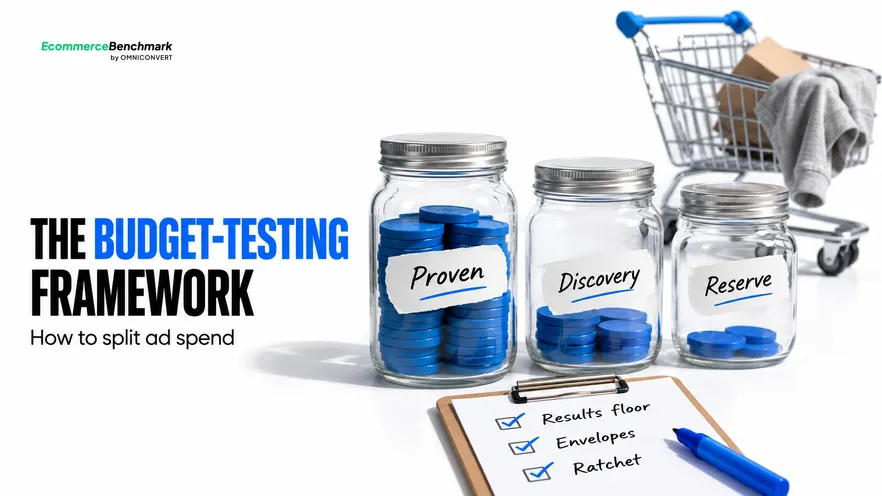
The Budget-Testing Framework: How to Split Ad Spend
The budget-testing framework splits ad spend into three envelopes and ends tests on a results floor, so winners stop being killed on day three.
The Ecommerce Benchmark Team
Ads
How to Structure a Meta Testing Campaign
How to structure a Meta testing campaign: run discovery and scaling as two campaigns, with a ring-fenced budget and exit rules written before launch.
The Ecommerce Benchmark Team
Benchmarks
Ad & Conversion Benchmarks for Fashion Brands (2026)
Ad and conversion benchmarks for fashion brands mislead until you adjust for returns and markdown timing. The four adjustments that make them readable.
The Ecommerce Benchmark Team
Benchmarks
Ad & Conversion Benchmarks for Beauty Brands (2026)
Ad and conversion benchmarks for beauty brands move with your replenishment mix, not your pages. The four adjustments that make the numbers comparable.
The Ecommerce Benchmark Team
Market Intelligence
How to Research Competitors in Food and Beverage
To research competitors in food and beverage, read the repeat-purchase signals: subscription depth, bundle architecture, flavour churn and review cadence.
The Ecommerce Benchmark Team
When to Consolidate vs Split Your Ad Sets
When to consolidate vs split your ad sets comes down to one test: split for a different budget decision, never for a different report.
The eCommerceBenchmark Team
Paid Social
Manual Bidding vs Cost Caps vs Bid Caps
Manual bidding vs cost caps vs bid caps comes down to which constraint you can actually state, and whether your volume makes a cap feasible at all.
The Ecommerce Benchmark Team
Paid Social
Advantage+ vs Manual Campaigns: When Each Fits
Advantage+ vs manual campaigns is a trade in diagnosability, not control. Harvest with one, learn with the other, and keep the two apart.
The Ecommerce Benchmark Team
Paid Social
Broad Targeting vs Interest Stacks in 2026
Broad targeting vs interest stacks is now a question about creative supply, not audiences. Which one your account can actually feed decides it.
The Ecommerce Benchmark Team
Market Intelligence
How to Research Competitors in Consumer Electronics
How to research competitors in consumer electronics when the product is identical: spec deltas, repricing behaviour and marketplace listings.
The Ecommerce Benchmark Team
Competitor Research
How to Research Competitors in Supplements and Wellness
Research competitors in supplements in five passes, starting with dose economics: cost per serving, days of supply, evidence and subscriptions.
The Ecommerce Benchmark Team
Competitor Research
How to Research Competitors in Home and Garden
Research competitors in home and garden on landed cost, not list price. Five passes: delivery, lead times, assembly, dimensional data and bulk returns.
The Ecommerce Benchmark Team

Competitor Research
How to Research Competitors in Skincare
Research competitors in skincare in five passes: claims, ingredient transparency, routines, subscriptions and recent reviews. What to collect, in order.
The Ecommerce Benchmark Team
Market Intelligence
How to Research Competitors in Fashion
To research competitors in fashion, read drop cadence, markdown timing and size range. A five-layer method, and what each layer tells you.
The Ecommerce Benchmark Team
Market Intelligence
How to Research Competitors in Beauty
To research competitors in beauty, read claim vocabulary, shade depth, bundle design and review velocity. Five layers, and what each one actually reveals.
The Ecommerce Benchmark Team
Market Intelligence
How to Find Saturated Ad Angles in Your Niche
Saturated ad angles are crowded arguments, not tired formats. How to census the angles running in your niche and find the one nobody is claiming.
The Ecommerce Benchmark Team
Market Intelligence
How to Benchmark Your Store in 15 Minutes
You can benchmark your store in fifteen minutes by comparing six observable things across three real competitors. The pass, and what to ignore.
The Ecommerce Benchmark Team
Market Intelligence
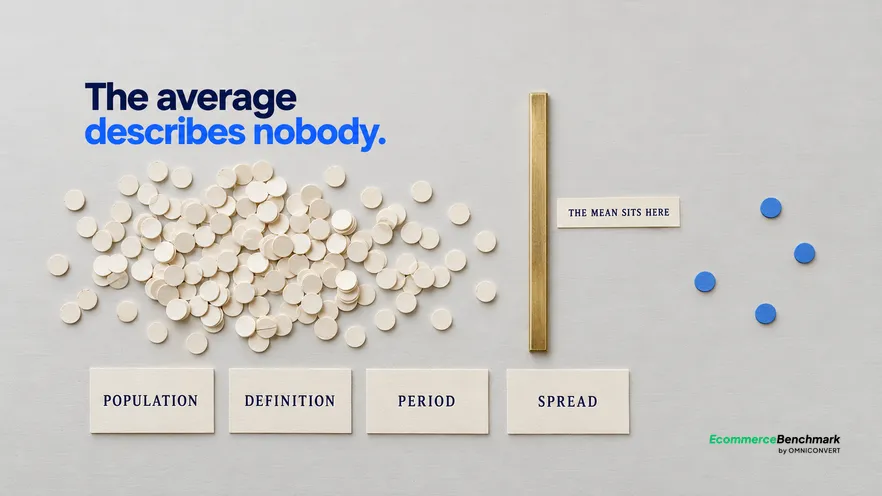
How to Read an Industry Benchmark Without Being Misled
An industry benchmark is a distribution reported as a number. Four questions tell you whether a published figure describes stores like yours at all.
The Ecommerce Benchmark Team

Market Intelligence
What Is Competitive Intelligence for eCommerce?
Competitive intelligence for eCommerce is a decision process, not a research habit. Here is the definition, the four questions, and where it fails.
The Ecommerce Benchmark Team
Competitor Research
9 Competitor Research Tools Every DTC Brand Should Use
Nine competitor research tools, what each one can honestly tell you, and the specific thing each one will mislead you about if you read it alone.
The Ecommerce Benchmark Team
Market Intelligence
What Is a King Ad, and How to Find Yours
A king ad is the one creative carrying a disproportionate share of an account. Here is the working definition, four tests, and how to find yours.
The Ecommerce Benchmark Team
Competitor Research
5 Competitor Signals Worth Tracking Weekly
Most competitor monitoring runs at the wrong frequency. The five competitor signals worth tracking weekly, and why the rest is noise at that cadence.
The Ecommerce Benchmark Team
Competitor Research
How to Find a Competitor's Best-Selling Products
You cannot see a competitor's sales, but four public signals converge on their best-selling products. How to read each one, and how each misleads.
The Ecommerce Benchmark Team

Competitor Research
How to Analyse a Competitor's Pricing and Offers
To analyse a competitor's pricing, record the effective price rather than the list price. The six fields to log and the cadence that works.
The Ecommerce Benchmark Team
Competitor Research
How to Benchmark Your Messaging Against Competitors
To benchmark your messaging against competitors, inventory the claims rather than the copy, then score each one on specificity and uniqueness.
The Ecommerce Benchmark Team

Competitor Research
How to Run a Quarterly Competitor Audit
A quarterly competitor audit is only useful if the axes never change. The cadence, the three competitors to pick, and the one decision it has to produce.
The Ecommerce Benchmark Team
Competitor Research
How to Map a Competitor's Full Funnel
Map a competitor's full funnel by walking it as a customer. The five doors to enter by, what to capture at each, and the two steps almost nobody reaches.
The Ecommerce Benchmark Team
Competitor Research
Competitor Teardown Template: What to Score and How to Act
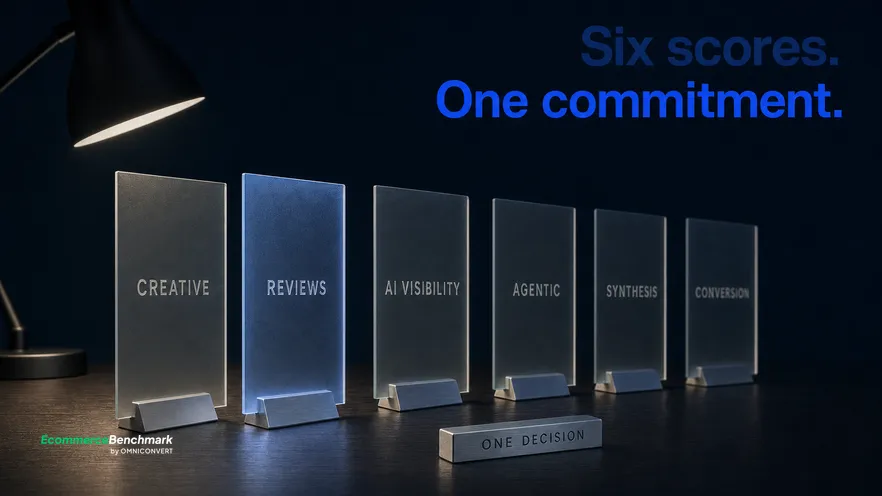
A competitor teardown is only useful if it ends in a decision. The six dimensions to score, the evidence each needs, and how to act on it.
The Ecommerce Benchmark Team
Ad Creative
How to Reverse-Engineer Why an Ad Is Winning
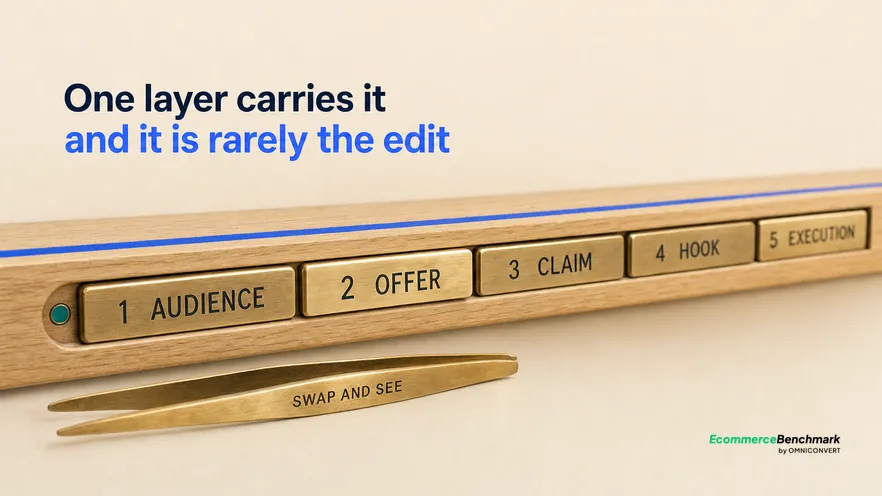
Why an ad is winning is never the edit. The Five-Layer Teardown and the Substitution Test that isolate the element actually carrying it.
The Ecommerce Benchmark Team
Ad Creative
How to Turn a Competitor's Winning Ad Into Your Own
Adapting a competitor ad is translation, not copying. The Three Gates it must clear, and the brief that keeps the mechanism and drops the artwork.
The Ecommerce Benchmark Team
Ad Creative
A Repeatable Process for Finding Winning Ads in Your Niche
Finding winning ads is a weekly sweep, not a browse. The Four-Pass Sweep: build the watchlist, read longevity, capture variants, and log the pattern.
The Ecommerce Benchmark Team
Competitor Research
How to Spot a Winning Ad: Scalers vs Tests
To spot a winning ad, watch what an advertiser commits to it rather than how good it looks. Five observable signals separate a scaler from a test.
The Ecommerce Benchmark Team
Competitor Research
6 Signals a Competitor Ad Is Scaling
A competitor ad that is scaling leaves marks even though spend is private. Six observable signals, ranked by reliability, and the Persistence Test.
The Ecommerce Benchmark Team
Competitor Research
7 Tools for Spying on Competitor Ads
Seven sources for spying on competitor ads, what each one can actually see, what none of them can see, and which question to take to which.
The Ecommerce Benchmark Team
Competitor Research
How to Build a Competitor Ad Monitoring System
A competitor ad monitoring system is a standing routine, not a periodic sweep. What to watch, what to record, and how to tell a real change from noise.
The Ecommerce Benchmark Team

Competitor Research
How to Find Which Competitor Ads Are Actually Working
Longevity does not mean competitor ads are working. The re-paste test, the four false positives, and how to isolate the element actually carrying one.
The Ecommerce Benchmark Team

Competitor Research
How to Track a Competitor's Ad Spend and Scaling Signals
Nobody publishes their budget, so competitor ad spend is inferred rather than read. The five signals that are genuinely observable, and how to log them.
The Ecommerce Benchmark Team

Reverse-Engineer Competitor Ads With the Meta Ad Library
The Meta Ad Library shows no spend and no results for commercial ads. What it does show, and how to read winners from duration and variation.
The Ecommerce Benchmark Team
Ad Creative
ABO vs CBO: Which Meta Campaign Structure Wins, and When
ABO vs CBO on Meta is a decision about what you are trying to learn: ABO protects a clean test, CBO chases efficiency once the winners are known.
The Ecommerce Benchmark Team

How to Benchmark Your Shopify Store Against Competitors (Step-by-Step)
Benchmark your Shopify store against real competitors across six dimensions, from creative to AI visibility. A step-by-step method to turn each gap into a ranked, testable action.
The Ecommerce Benchmark Team
Shopify
What Is a Shopify Store Audit? (2026 Benchmark Guide)
A Shopify store audit measures your store against real benchmarks to find the friction costing you sales. See what it checks, how to run one, and how to read the results.
The Ecommerce Benchmark Team
Ad Creative
The Winning-Ad Scorecard: 8 Criteria to Judge Any Creative
What makes a winning ad: eight criteria for judging any creative before you spend, scored the same way every time, so the decision stops being taste.
The Ecommerce Benchmark Team

Competitor Research
The DTC Competitor Research Stack: Four Layers
A competitor research stack turns ads, pricing, messaging and CRO signals into decisions. Here are the four layers, and how to read each one honestly.
The Ecommerce Benchmark Team
Ad Creative
Hook, Angle, CTA: The Anatomy of a High-Converting Ad
A high-converting ad has three separable parts, and each fails in its own way. Here is how to tell which one is broken before you rewrite anything.
The Ecommerce Benchmark Team

What Is Agentic Commerce Readiness? A Practical Definition for 2026
Agentic commerce readiness is whether an AI shopping agent can discover, evaluate, and buy from your store. See what makes a store ready and how the Ecommerce Benchmark scores it.
The Ecommerce Benchmark Team

What Is an Ecommerce Benchmark Score? How Store Scoring Works (2026)
An ecommerce benchmark score ranks your Shopify store against real competitors across six named dimensions, not one generic grade. See how store scoring works.
The Ecommerce Benchmark Team

AI Visibility for Shopify Stores: Are You Cited in ChatGPT and Perplexity?
AI Visibility measures whether ChatGPT, Perplexity, and Gemini cite your Shopify store when shoppers ask for recommendations. See how it is scored, why it matters now, and how to check yours.
The Ecommerce Benchmark Team

The 6 Areas That Actually Predict Ecommerce Store Performance
Six named areas predict ecommerce store performance better than any single grade: Creative & Ads, Reviews & UGC, AI Visibility, Agentic Commerce, Competitor Synthesis, and CRO. See what each one predicts and where most stores fall short.
The Ecommerce Benchmark Team