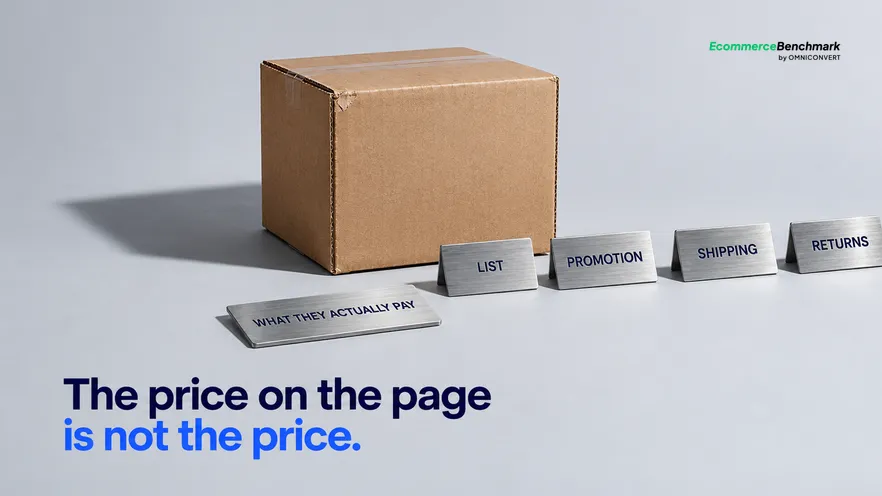
Effective price is defined as the total a shopper actually pays for a product at a given moment, after the promotion in force, the shipping charged at a typical basket value and any bundle or subscription discount. That is the number to analyse a competitor's pricing against, and it is frequently different from the list price on the page. The method is a fixed basket of eight to fifteen products that exist on every competitor and will still exist in a year, sampled on the same weekday, with six fields recorded per product: effective price, list price, mechanic, depth, shipping threshold and return terms. Read the quarter rather than the reading, because one sample taken during a competitor sale will suggest a price move that never happened.
- List price is the least informative number on a competitor's product page.
- Fix the basket and fix the weekday. A drifting sample measures the sale calendar.
- Record the mechanic as well as the depth. Bundling and headline cuts mean different things.
- Shipping thresholds and return terms are more stable than prices and often more revealing.
- Never match on one observation. Establish first whether the gap is permanent or promotional.
To analyse a competitor's pricing in a way that supports a decision, record what a shopper actually pays rather than what the page advertises. Omniconvert has measured commercial behaviour across 70,000+ experiments and 13 years in eCommerce, and the recurring error in competitor pricing work is not sloppy collection. It is collecting the wrong number carefully. Nexus by Omniconvert is the AI for eCommerce growth engine that unifies commerce data, prioritises experiments by True Profit and generates campaigns and creative you approve before they go live, and the True Profit framing is the relevant part here: a price comparison that ignores shipping and returns is comparing two numbers that neither business runs on. Last updated: October 2026.
This article covers the pricing and offer axis only. For the whole set, see the DTC competitor research stack, and for the companion axis on language rather than price, benchmark your messaging against competitors.
Why you cannot analyse a competitor's pricing from a list price
The argument is easiest to see by walking a shopper through both stores rather than by reading both pages.
A product listed at the same figure on two sites can cost differently at checkout for at least four reasons: one store has a promotion running, one charges shipping below a threshold the other sets lower, one offers a multi-pack that changes the per-unit cost, and one has a subscription rate that most of its buyers take. None of those appears in a list-price comparison.
The second problem is that list price is partly a positioning decision. A store may hold a high list price and discount continuously, which is a different strategy from holding a lower list price steadily, and the two look identical in a snapshot. Only an effective price series separates them.
The third problem is that list prices are the easiest thing to collect, which is why most competitor pricing work is built on them. Ease of collection is not evidence of usefulness, and a scraper returning hundreds of list prices weekly produces a dataset nobody reads and no decision.
Google's documentation on product structured data is worth knowing here, because where a competitor publishes price and availability in markup it is both easier to read reliably and more likely to be the list rather than the effective figure.
The six fields to record per product
Each field earns its place by answering something the others cannot.
Effective price. The total a shopper pays, computed at your own common basket value so that shipping is included on a comparable basis. This is the series you will trend.
List price. Kept alongside, because the gap between list and effective is itself the measurement of how promotional a competitor is.
Mechanic. One short phrase: percentage off, bundle, multi-buy, free shipping, subscription rate, code at checkout. A store moving from headline cuts to bundles has changed strategy, and the depth figure alone will not show it. Meta's Ad Library is the fastest way to see which mechanic a competitor is paying to promote this week, which often leads the on-site change by a few days.
Depth. How much the mechanic took off, in the same unit each time. Recorded as a figure you compute rather than one you copy from a banner.
Shipping threshold. The basket value at which delivery becomes free, plus the charge below it. This moves rarely and matters a great deal, which makes it high-value and cheap to track.
Return terms. The window and who pays return postage. The most stable field and frequently the most revealing, because a quiet shortening of a return window is a strategic signal a price series will never contain.
| Field | What to record | What it answers | How often it moves |
|---|---|---|---|
| Effective price | Total paid at a typical basket | What the shopper compares | Weekly, with promotions |
| List price | The figure on the page | Their positioning intent | Quarterly at most |
| Mechanic | Percentage, bundle, code, subscription | Which strategy they are running | Seasonally |
| Depth | Computed reduction, same unit | How hard they are pushing | Weekly |
| Shipping threshold | Free-delivery value and the charge below | Their real entry price | Rarely, and it matters |
| Return terms | Window and who pays postage | Confidence in their own product | Rarely, and it signals |
The bottom two rows are the ones most often omitted and the ones a shopper weighs most heavily when two prices are close. Baymard Institute's checkout research documents how much unclear delivery and return terms cost at the point of purchase, which is the reason to treat them as pricing fields rather than as policy details.
The sampling rule that keeps the series readable
The discipline here is the same as any other repeated measurement: hold the instrument still.
Weekday matters because promotional calendars are weekly. A competitor whose sales start on Thursday and end on Sunday will appear cheap or expensive depending on when you looked, and a series sampled on a drifting day will show swings that are entirely artefacts of your own timing.
The basket matters because composition changes the average. Add two expensive products to your tracked set in month three and the series steps up for reasons that have nothing to do with anybody's pricing. Choose products that will still exist in a year, and accept a smaller set in exchange for that stability.
Time of day matters less and still matters, because flash promotions and regional pricing can both vary within a day. Sampling in the same two-hour window removes the question.
On automation: collect what automates cleanly and compute the rest by hand. A script can read list prices and detect a banner. It cannot reliably compute an effective price at a basket value, read a bundle's composition or notice that a return window changed from thirty days to fourteen. Twelve products checked properly each week is a better dataset than three hundred collected badly.
What a growth team should do this week
- Choose the basket. Eight to fifteen products that exist on every competitor you track and will still exist in a year. Write the list down and date it.
- Record the six fields once, by hand, for three competitors. Expect ninety minutes for the first pass and twenty for every pass after that.
- Compute the effective price gap at your own common basket value, not at a single-item value. This is the number to take to a pricing conversation.
- Diarise the next pass for the same weekday and the same two-hour window. Put it in a calendar, because this is the step that fails.
- Get your free benchmark score. Ecommerce Benchmark scores your store across six dimensions, including AI Visibility and Agentic Commerce, against real competitors in your category and country, which puts the pricing picture next to the other five.
Where order, margin and promotional data sit in separate systems and have to be assembled before an effective price gap can even be computed on your own side, that unification is what Nexus addresses, ranking the next actions by True Profit with a person approving what goes live. Once you know where you rank, Omniconvert Explore is the CRO platform for testing the offer change against a control rather than shipping it.
FAQ: analysing competitor pricing and offers
How do you analyse a competitor's pricing properly?
Record the effective price rather than the list price, on a fixed basket of products, sampled on the same weekday each time. The effective price is what a shopper actually pays after the promotion in force and the shipping charged at a typical basket value, and it is frequently a different number from the one on the product page. A list-price comparison tells you what two stores publish, which is a marketing decision rather than a commercial one.
How often should you check a competitor price?
Weekly on a fixed weekday for a tracked basket, and that is enough for almost every category. Daily sampling mostly records the promotional calendar and generates a chart nobody can read. The fixed weekday matters more than the frequency, because promotions overwhelmingly start and end on particular days, so a sample that drifts across the week is measuring the sale cycle rather than the underlying price.
Is it worth matching a competitor on price?
Rarely, and never on a single observation. Matching assumes the two offers are otherwise equivalent, which is almost never true once delivery speed, return terms, warranty and bundle contents are included. The more useful response to a price gap is to establish whether it is permanent or promotional, and if permanent, whether your offer carries something their price does not include. Competing on terms is usually cheaper than competing on headline price.
What offer details matter besides the discount?
The shipping threshold, the return window and who pays return postage, the mechanic of the promotion, and whether a subscription or bundle price exists. These frequently decide a purchase when two headline prices are close, and they are more stable than prices, which makes them a better read on a competitor strategy. A store that quietly shortens its return window has told you something a price comparison never would.
Can you automate competitor price tracking?
Partly, and the part that automates is the part that matters least. Collecting list prices is straightforward to automate, while computing the effective price needs a basket, a shipping calculation and a reading of the promotional mechanic. Most teams get further with a fixed basket of a dozen products checked by hand each week than with a scraper returning hundreds of list prices nobody interprets.
The bottom line
Competitor pricing work fails in a specific and avoidable way: it collects the number that is easiest to collect and then cannot answer the question that gets asked. The question is almost always whether a gap is permanent or promotional, and only an effective price series on a fixed basket sampled on a fixed weekday can answer it. So choose a dozen products that will still exist next year, record six fields rather than one, and compute the total at your own common basket value so shipping is in the comparison. Keep the shipping threshold and the return terms in the log even though they barely move, because when they do move they are telling you something a price never does. Then read the quarter rather than the reading, and resist matching anything on the strength of one observation.