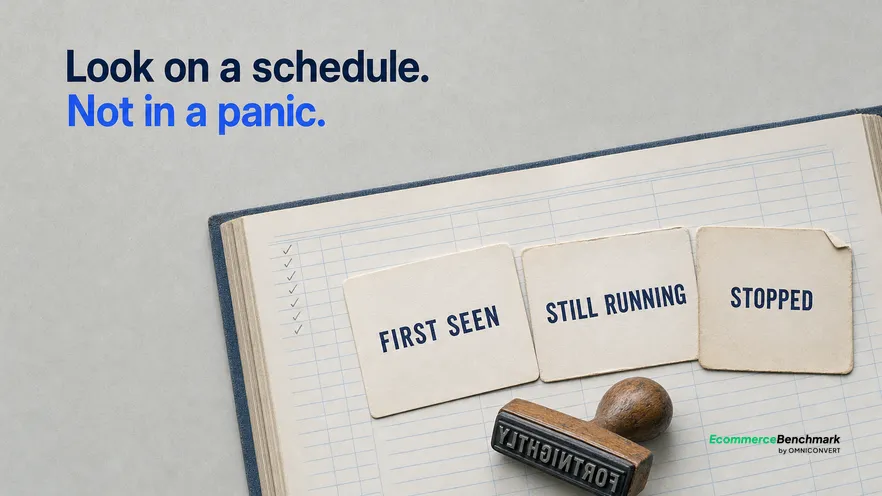
A competitor ad monitoring system is a standing routine rather than a research project: a fixed watchlist of five to eight rivals, a fixed cadence of roughly a fortnight, and the same handful of fields recorded on every pass, so that a change in a competitor's advertising is noticed while it is happening. The value does not come from seeing more ads. It comes from having an evenly spaced record, because a start date and a stop date only mean something against previous observations. Run duration is the one performance hint visible from outside an account, and the output you want is a hypothesis to test on your own traffic, never a finished asset to copy.
- A short watchlist you actually read beats a long one nobody opens.
- Evenly spaced observations are what make start and stop dates readable; regularity beats frequency.
- Fixed fields are comparable across months. Free-form notes are not.
- Run duration is the only performance signal visible from outside, and it is weak evidence, not a result.
- Every review ends in a written decision, including the decision to change nothing.
A competitor ad monitoring system is a repeatable routine that records what a named set of rivals are advertising, when each ad appeared and disappeared, and what changed since the last look. Most teams believe they have one. What they usually have is a habit of checking competitor ads when performance dips, which produces a snapshot at the least representative moment. Last updated: September 2026.
Omniconvert has measured what separates stores that compound advertising performance from stores that restart each quarter, across 70,000+ experiments and 2,500+ Shopify stores over 13 years in eCommerce. The pattern is consistent and slightly deflating: the advantage rarely comes from better competitor intelligence. It comes from having noticed a category shift early enough to respond deliberately rather than reactively, and noticing early is a function of looking regularly, not of looking harder.
This guide covers the routine itself. For reading one competitor's advertising in depth once you have decided they matter, start with how to Reverse-Engineer competitor ads with the Meta ad library, and for where advertising sits among the other things worth tracking, the DTC competitor research stack.
What a competitor ad monitoring system actually is
The distinction worth holding is between research and monitoring. Research answers a question you have now: what is this competitor doing, why does their offer look like that, how are they positioning against us. It is deep, occasional and driven by curiosity. Monitoring answers a question you have not asked yet: what changed. It is shallow, frequent and driven by a calendar.
Teams are good at the first and almost universally bad at the second, because research feels productive and monitoring feels like admin. The consequence is that competitor knowledge arrives in bursts separated by long silences, and the silences are where category shifts happen unobserved.
Meta's Ad Library made the raw material public and free for any advertiser running in its network, which removed the access problem entirely [Meta Ad Library]. What it did not remove is the discipline problem. An archive that anyone can open at any time is precisely the kind of resource that gets opened at no particular time.
Why the periodic sweep fails
Three failures follow from irregular looking, and they compound.
The first is that you cannot date anything. Seeing an ad tells you it exists. Seeing it twice, six weeks apart, tells you it has run for at least six weeks, and that second fact is the one carrying information. A single sweep produces a list of ads with no durations attached, which is a catalogue rather than a record.
The second is recency bias in the worst direction. Sweeps get triggered by bad news, so the competitor set is inspected exactly when your own team is most inclined to read rival activity as an explanation. A competitor's new campaign becomes the reason for your soft month, when the more likely reason is seasonal, or a creative of your own that fatigued, or a checkout change nobody logged.
The third is that findings do not accumulate. Each sweep starts from nothing, so the same observations get rediscovered repeatedly and genuine changes get missed, because a change is a difference between two states and a sweep only ever captures one.
The Standing Watch Loop: five parts, about an hour a fortnight
- Fix the watchlist. Five to eight competitors, named, with one line each saying why they are on it. The reason matters more than the name: a direct substitute, a price leader, a category newcomer and an adjacent brand moving into your space are being watched for different reasons and will be read differently. Review the list quarterly and take names off it.
- Fix the cadence. A fortnight suits most categories. Put it in a calendar with a named owner. The interval is less important than its evenness, because evenly spaced observations are what turn a sighting into a duration.
- Record fixed fields. The same columns every time, filled the same way. This is the step people skip in favour of a folder of screenshots, and it is the step that makes the record usable a year later.
- Separate the change from the noise. New ads are mostly noise; most creative fails and gets switched off. Signal is a sustained shift in what a competitor argues, or an ad that keeps running long after its siblings stopped.
- Attach a decision. Every review ends with a written line: this is what we will do differently, or explicitly nothing changes. Without it the record grows and nothing follows from it, which is how monitoring quietly becomes a hobby.
The loop is designed to survive a busy quarter. A system that needs four hours a fortnight will be skipped in the month when skipping it costs the most, and a skipped month breaks exactly the property the whole thing is built on.
What to record, and what to leave out
| Field | Why it earns its place | Common mistake |
|---|---|---|
| First seen | Anchors every duration you will later calculate | Recorded as "recently" |
| Still running | The only externally visible performance hint | Never revisited, so nothing is ever dated |
| Format | Shows where a rival is placing its production budget | Described in detail nobody reads |
| Stated offer | Discounting shifts are the earliest visible margin signal | Inferred when no offer is stated |
| Leading claim | Captures the argument, which is the part that shifts | Summarised differently each time |
| Landing destination | Separates a catalogue push from a single-product bet | Omitted because it is one extra click |
| Estimated spend | Does not earn its place: it cannot be observed | Invented, then quoted internally as fact |
The last row is the one worth dwelling on. Estimated competitor spend is the most requested field in any monitoring template and the least defensible, because nothing visible from outside an ad account supports it. A number written into a spreadsheet loses its uncertainty within about two weeks and then circulates as a fact, and decisions get made against it. Leave the column out rather than filling it with a guess.
Note also what the leading claim column really tracks. Individual ads are not the interesting unit. What a category argues about is the interesting unit, and it moves slowly enough that a fortnightly record catches it clearly: a market that argued about price for two years beginning to argue about delivery speed is a strategic fact, visible months before it appears in anyone's performance data.
How to read a change once you have spotted one
A competitor's shift to heavier discounting might be an aggressive share grab. It might equally be an inventory problem, a supplier change, a new investor with a growth target, or a rational response to their own soft quarter. These call for opposite responses, and the ad itself cannot distinguish between them.
What the record can do is tell you whether the change persisted. A discount that runs for three weeks and stops was a clearance. The same discount still running after three months is a repositioning, and that is worth responding to. Duration is the closest thing to evidence this discipline offers, which is the whole reason the cadence matters.
The second question is whether the change is one rival or the category. One competitor moving is a competitor decision. Three moving the same way within a quarter is a market movement, and Statista's tracking of retail promotional intensity shows category-wide discounting patterns shifting on roughly that timescale rather than instantly. A watchlist of five to eight is enough to tell those two cases apart, and a watchlist of two is not, which is the real argument for its size.
What a performance marketer should do this week
- Write the watchlist down. Five to eight names, one line each on why. Expect to find that two of them are not really competitors and one important newcomer is missing.
- Create the sheet with six columns. First seen, still running, format, offer, leading claim, destination. Resist a seventh.
- Do the first pass and date it. The first pass has no comparisons in it and will feel pointless. It is the baseline, and everything the system produces later is measured against it.
- Put the second pass in the calendar now, with a named owner. The second pass is where the system starts working and where most attempts have already stopped.
- Turn the first real finding into a test, not a copy. A rival's argument is a hypothesis about your market. Omniconvert Explore is the CRO platform for that step: A/B and multivariate testing, on-site surveys, heatmaps and segmentation.
Where the number of competitor signals outgrows the capacity to act on them, the constraint stops being observation and becomes prioritisation. Nexus by Omniconvert is an AI for eCommerce growth engine that unifies your commerce data, prioritises experiments by True Profit, and generates campaigns and creative you approve before they go live, which keeps the queue ordered by profit rather than by whichever competitor moved most recently.
Knowing where you stand against the category is the other half of this. A free leaderboard score places your store across six dimensions, including Creative and Ads, and the paid report breaks down where the gap actually sits.
FAQ: competitor ad monitoring
How many competitors should a monitoring system track?
Fewer than feels comfortable. Five to eight is enough for almost every store, and the limit is not the effort of looking but the effort of reading what you collected. A watchlist of twenty produces a folder nobody opens, which is worse than tracking three properly because it also carries the belief that competitors are being watched.
How often should I check competitor ads?
Every two weeks suits most categories, and the regularity matters more than the interval. Monitoring produces its value from evenly spaced observations, because that is what makes a start date and a stop date meaningful. Checking daily for a fortnight and then not again for a quarter yields a much weaker record than a steady fortnightly rhythm.
What should I record about each competitor ad?
Record the same fields every time: first seen, still running or stopped, the format, the offer if one is stated, the claim the ad leads with, and the landing destination. Fixed fields are what let an entry from March be compared with one from September. Free-form notes feel richer at the time and are almost impossible to compare later.
How do I know if a competitor ad is actually working?
You cannot know, and any system that claims to is selling an inference as a fact. What you can observe is how long an ad keeps running. Sustained duration across repeated observations is weak evidence that a rational advertiser has not switched it off, which is the only performance signal visible from outside. Treat it as a hint about where to look, never as a result.
Is competitor ad monitoring worth it for a small store?
Yes, and it is more valuable at small scale, because a small store cannot afford to discover a category-wide shift in positioning two quarters late. The cost is around an hour a fortnight. The alternative is not saving that hour, it is learning the same information from a decline in performance that takes months to diagnose.
What is the difference between monitoring and copying competitor ads?
Monitoring tells you what a market is arguing about. Copying takes a specific execution and repeats it with your own logo, which reliably underperforms because the execution was built for a different product, price point and audience. The useful output of monitoring is a hypothesis you then test on your own traffic, not a finished asset.
The bottom line
The reason to build a competitor ad monitoring system is not that you will find a winning ad to borrow. It is that categories change their argument slowly and visibly, and a team looking on a schedule sees that happen while a team looking in a panic sees only a snapshot taken on its worst day. The whole apparatus is a short list, a recurring calendar entry, six columns and a written decision at the end of each pass. That is unglamorous enough that it gets postponed indefinitely in favour of a richer system that never gets built. Build the small one this week, run it twice, and let the second pass be the thing that convinces you, because the second pass is the first one that can show you a difference.