

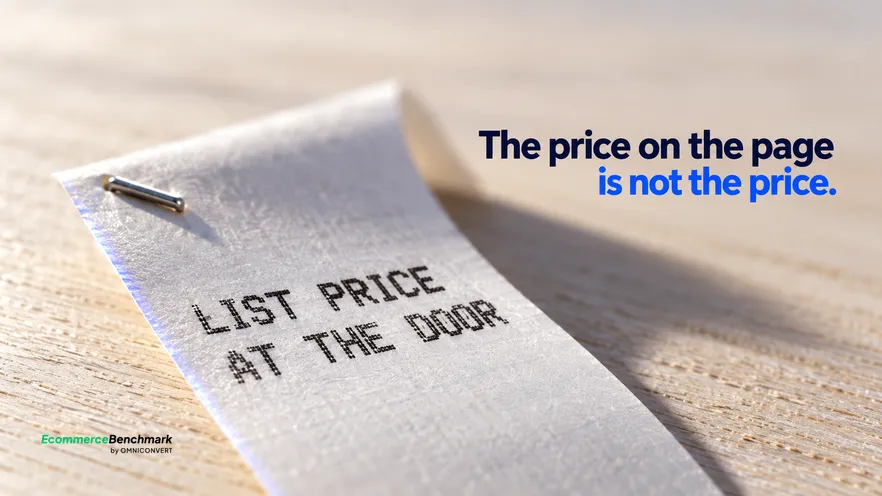
Landed cost is defined as the total a buyer pays to have a large item standing in the room they want it in, including delivery, any access or distance surcharge, and any assembly fee. To research competitors in home and garden, compare on that rather than on list price, because the gap between the two is large in this category and usually appears late on purpose. Around 70% of carts are abandoned across retail, with unexpected cost the most persistent single cause [Baymard Institute, 2025]. This guide sets out five passes, what each one is for, and how to turn the output into facts you publish earlier than your rivals do.
- Compare on landed cost, because list price decides almost nothing here.
- Take every competitor's largest item to the last step before payment.
- Record where the product page and the checkout disagree on lead time.
- Check packed size and access clearance, the two fields that fail deliveries.
- Read who pays for collection and whether original packaging is required.
- Publish the awkward numbers earlier than rivals do, as the competitive move.
Omniconvert has measured how commercial pages disclose cost and availability across the CROBenchmark dataset of 7,000+ websites in 15+ industries, against 248+ audit criteria, over 13 years in eCommerce [CROBenchmark Report 2026, Omniconvert]. Bulky categories show the widest gap between the first number a shopper sees and the number they are finally asked to pay, which is both the category's main source of abandonment and its clearest opening.
Why five passes beat one sweep when you research competitors in home and garden
The usual competitor exercise in this category gathers photographs, prices and positioning from product pages. That is the one part of a home and garden proposition where everybody looks similar, and it is the part that decides least.
What differentiates is what happens after the add to basket: what delivery costs, when it arrives, who carries it upstairs, and who pays if it does not fit. None of that is on the product page, so the research has to go further than a browse.
The cross-category framework behind this is the DTC competitor research stack.
Pass one: landed cost
Pick a comparable large item from each of six competitors, add it to the basket, and go as far as the payment step with the same delivery postcode. Record the product price, the delivery charge, any surcharge for distance or access, and any assembly fee as four separate numbers.
You will usually find at least one brand whose keen list price is recovered entirely in delivery, and at least one whose inclusive pricing looks expensive on the product page and is competitive at the door. Both are commercially useful and neither is visible from a browse.
The mistake this pass invites is reading the result as a pricing instruction. A team discovers a rival is cheaper landed, drops delivery charges to match, and finds the margin gone within a quarter because the rival's advantage was a freight contract rather than a decision. Landed cost tells you what the buyer experiences; it does not tell you what you can afford, and those are two different research questions.
Pass two: lead-time honesty
Lead times in this category are long enough to be a purchase criterion in their own right, which makes them worth misrepresenting and therefore worth checking. Note the product page figure, the checkout figure, and any wording that converts a date into a hope.
The useful finding is rarely that a rival is slow. It is that a rival is slow and says so late. Unexpected delay and unexpected cost have been among the leading reasons shoppers abandon purchases for as long as Baymard Institute has measured it, at around 70% average cart abandonment [Baymard Institute, 2025], and a late correction produces the same loss as a bad number stated honestly would have avoided.
Pass three: assembly and service
| Pass | The question it answers | Effort |
|---|---|---|
| Landed cost | What the buyer actually pays | One hour |
| Lead-time honesty | Who is slow and says so late | One hour |
| Assembly and service | Who solves the hard part | Half a day |
| Dimensional data | Who can be checked for fit | Half a day |
| Bulk returns | Where the margin risk sits | Two hours |
| Ranking all five | What to publish and what to test | One afternoon |
Read the third row as the one most likely to be mispriced across a category. Assembly and two-person delivery are expensive to supply and extremely valuable to a buyer who has already worked out that a wardrobe will not go up the stairs alone, and the brands that bundle it rarely say so prominently enough.
Pass four: dimensional data
Dimensional completeness is defined as the condition in which a product publishes its assembled size, its packed size, its weight and the access clearance a delivery requires, all as values rather than as a diagram. It is the pass that most directly predicts failed deliveries and returns.
Check six competitors on those four fields and you will usually find assembled dimensions everywhere, weight sometimes, and packed dimensions almost nowhere. Shopify's merchant guidance has pushed complete, consistent product data across sales channels for years [Shopify, 2026], and this is a case where the missing field has a freight cost attached rather than a marketing one. The vocabulary for publishing it is at schema.org's product type.
Pass five: bulk returns
Collecting a sofa is expensive, so returns policies in this category are written carefully. Read them for three things: whether collection is free, whether the original packaging is required, and whether a restocking deduction applies. Then read recent reviews for what happened when somebody tried.
The combination is the finding. A rival whose stated policy is generous and whose reviews describe collection difficulties has a gap between promise and practice, and that gap is both a competitive opening and a warning about what your own policy will cost you if you copy it.
AliveCor used Omniconvert to run a structured A/B testing programme and achieved +21% conversion rate, +5% revenue per visitor, and 94% statistical relevance across their experiments. [Omniconvert, AliveCor case study] That is a conversion testing result from a different category, and the transferable discipline is to prove one disclosure change at a time rather than redesigning the whole checkout and attributing the result to the idea you preferred.
What to do this week
- Build the landed-cost table. Six competitors, one comparable large item each, four numbers apiece, same postcode. One hour, and it is the whole business case.
- Find the two worst lead-time disagreements. Product page against checkout. Then check your own, honestly, before you use it against anybody.
- Publish one awkward number earlier. Delivery cost, packed size or access clearance, moved onto the product page. In this category disclosing sooner is the differentiator, because everyone is hiding the same figures.
Once you know where you stand, the free leaderboard entry is the quickest way to see your own six-dimension score against real competitors in your category and country, including the AI Visibility and Agentic Commerce dimensions most competitive tools do not measure. Downstream of that, Omniconvert Commander (formerly Nexus) is an AI for eCommerce growth engine that unifies commerce data, prioritises experiments by True Profit, and generates campaigns and creative you approve before they go live. The vertical companions are how to research competitors in fashion and how to research competitors in skincare, each of which sorts on a different axis.
Frequently asked questions
How do you research competitors in home and garden?
On landed cost rather than list price, in five passes: delivery and surcharges, lead-time honesty, assembly and service, dimensional data and bulk returns. List price is the least informative number in this category, because the gap between it and what a buyer actually pays to have the thing in the room is both large and deliberately late to appear.
What is landed cost in this category?
The total to have the item standing where the buyer wants it: the product, the delivery, any access or distance surcharge, and any assembly or installation fee. Two sofas with the same list price can differ substantially once all four are added, and only one of the four is usually visible on the product page.
Why does lead-time honesty matter so much here?
Because the waits are long enough to be a purchase criterion. A competitor promising two weeks on the product page and revealing ten at checkout is not simply being optimistic, it is spending its own credibility, and the abandonment it causes is a gap you can take by stating a longer true figure clearly.
Which dimensional fields actually decide a sale?
Assembled dimensions, packed dimensions, weight, and the access clearance the delivery needs. The packed size and the clearance are the two most often missing and the two that cause failed deliveries, because a buyer can measure a room easily and almost never thinks to measure a stairwell.
What should we look for in a competitor's returns terms?
Who pays for collection, the window, and whether the item must be repackaged in its original carton. Collection on a bulky item is expensive, so a generous-sounding policy with an original-packaging requirement is often much narrower than it reads, and that gap is where disputes and bad reviews come from.
How do we turn the five passes into something actionable?
Convert each pass into either a fact you should publish earlier than your rivals do or a test you should run, and discard anything that becomes neither. In this category publishing a cost or a clearance sooner than the competition is itself the competitive move, because they are all hiding the same numbers.
Go to the payment step
Spend one hour putting a comparable large item from six competitors into six baskets with the same delivery postcode, and take each one to the last screen before payment. Write down four numbers each. That table is worth more than any amount of product page comparison, because it is the only place the category's real prices are visible.
Then publish one of the awkward numbers earlier than your rivals do. Delivery cost, packed size or the clearance a delivery needs. Everybody in this category is holding those back, which is exactly why showing one is a differentiator rather than a disadvantage.