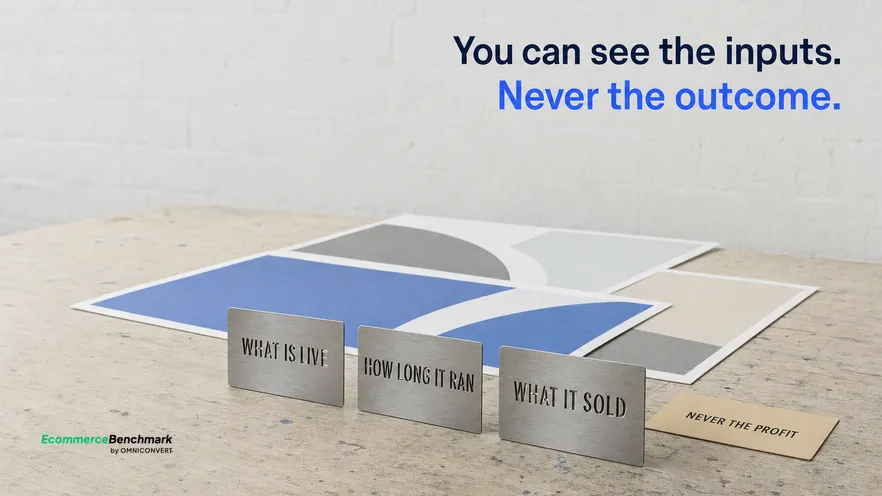
Seven sources cover almost all of spying on competitor ads, and they answer different questions. The platform ad libraries show you what is running right now, free and first-party. Longevity and variant trackers show you what has survived, which is the closest public thing to a performance signal. Landing page and offer monitoring shows you what the ad was actually selling. Review and social listening shows you how the promise landed. Creative marketplaces show you the format conventions of a category. None of the seven can tell you whether any of it made money, because no public source carries margin, return rate or repeat purchase. Start free, add paid tools only when the question becomes change over time.
- Platform ad libraries are free, first-party and complete for active ads. Start there.
- Longevity is the strongest public performance signal: somebody kept paying for it.
- Any precise competitor spend figure for a retail advertiser is a model, not a disclosure.
- The landing page is half the ad, and most research stops before reaching it.
- No public source shows margin, returns or repeat purchase, so none of them shows profit.
Spying on competitor ads is the practice of studying what rivals are publicly running in order to understand their offers, angles and creative conventions. It is useful, it is ordinary market research, and it is routinely done badly: a team opens an ad library, scrolls a competitor's creative, screenshots four ads that look good, and concludes very little. The difference between that and research is knowing which source answers which question. Last updated: September 2026.
Omniconvert has measured creative and advertising practice across the CROBenchmark dataset of 7,000+ websites in 15+ industries, against 248+ audit criteria, over 13 years in eCommerce. What separates teams that get value from this work is not tooling budget. It is that they go in with a question, and the question decides the source.
This piece sets out seven sources, what each genuinely reveals, and where each stops. For the method applied in depth to one source, see how to Reverse-Engineer competitor ads with the Meta ad library. For where ad research sits among the other intelligence you should be gathering, see the DTC competitor research stack.
Decide the question before the tool
What is running is a snapshot question, and the ad libraries answer it completely and for nothing. What has survived is a time-series question, which needs either patient manual observation or a tool that has been watching on your behalf.
What it is selling is a landing-page question, and it is the one most often skipped. An ad is half of an offer; the page it points at carries the price, the guarantee, the delivery promise and the actual argument. Studying the creative alone is studying the envelope.
How it landed is a customer-voice question, answered in reviews, comments and social replies rather than in any advertising tool. It is also the only one of the four that tells you something about the promise being kept, which is where a competitive advantage usually lives.
The seven tools for spying on competitor ads
1. The platform ad libraries. Meta's Ad Library, the Google Ads Transparency Center, TikTok's Creative Center and LinkedIn's ad library are first-party, free, and comprehensive for ads currently being served [Meta]. They are the only sources on this list that are authoritative rather than inferential, and they are where every piece of this work should start.
2. Longevity and variant trackers. A category of commercial tool that records what it sees in those libraries over time, so you can ask how long a creative has run and how many variants exist. This is the single most valuable derived signal available, because it substitutes duration for performance data nobody will give you.
3. Landing page and offer monitors. Tools that snapshot the destination page on a schedule. Price changes, guarantee changes, bundle changes and new claims all show up here, and they explain ad changes that are otherwise inexplicable.
4. Creative marketplaces and format libraries. Collections of advertising creative organised by format and category. Their value is conventions rather than competitors: what a category's ads generally look like, which is what you need in order to decide whether to conform or break the pattern.
5. Your own review corpus and theirs. Not usually thought of as an advertising tool, and it is the best source for whether a promise is being kept. A competitor advertising a fast delivery promise that their reviews complain about is handing you your positioning.
6. Social comment threads on the ads themselves. Public, free and rarely read. The replies under a paid social ad are the closest thing to a focus group anybody is going to give you, including the objections your own ads will meet.
7. Search and shopping results for your category. What competitors bid on, how they describe themselves in ad copy, and which promotional mechanics they lead with. Shopify has long pushed merchants to keep product feeds consistent precisely because these surfaces read from them, which makes the feed a competitive artefact as well as an operational one [Shopify].
What each source can and cannot see
| Source | Answers | Cannot see | Cost |
|---|---|---|---|
| Platform ad libraries | What is running now, in which markets | Anything that has stopped | Free |
| Longevity and variant trackers | What survived, and in how many versions | Why it survived | Paid |
| Landing page monitors | The offer, price and guarantee behind the ad | Traffic or conversion on it | Low to paid |
| Creative marketplaces | Category format conventions | Whether conventions perform | Free to paid |
| Review corpora | Whether the promise is kept | Which ad the buyer saw | Free |
| Ad comment threads | Live objections and misreadings | Anyone who scrolled past silently | Free |
| Search and shopping results | Bidding posture and lead offers | Budget, margin or profitability | Free |
The pattern in the third column is the argument of this article. Every public source is an input source. A competitor running a creative profitably and a competitor running the same creative into a loss produce identical evidence, and no amount of tooling resolves that, which is why longevity is the signal worth building on: it is the only observable that requires somebody to have kept choosing to pay.
How to read longevity without over-reading it
The logic is simple and worth stating precisely: an advertiser who is paying attention stops paying for creative that is not working, so duration is evidence of somebody's judgement. Variant count strengthens it, because producing variants of a concept is what teams do when a concept is performing.
The first failure case is the unattended account. Plenty of long-running ads are running because nobody has looked, particularly at larger advertisers and particularly in secondary markets. Duration without variant development should be discounted heavily.
The second is the brand campaign, which is not being judged on direct response at all and may run for a year regardless. Treat prospecting-style brand creative and offer-led direct response as separate populations, because the duration signal means something different in each.
What this research is for
Finding unused angles is the highest-value output and the one that needs the widest survey. Reading thirty competitor ads and listing the claims they make usually reveals that a category converges on two or three arguments and leaves obvious ones untouched.
Understanding the comparison offer matters because your shopper is holding it whether or not you are. If every competitor is advertising free returns and you are not, that is a fact about your conversion rate that no creative will fix.
Breaking conventions deliberately is the third, and it requires knowing them. Bain and Company's work with Fred Reichheld holds that a five percent improvement in retention can raise profits by twenty-five to ninety-five percent, which is worth holding next to a category that has spent its creative budget entirely on acquisition claims: the unused angle is frequently about what happens after the purchase [Bain and Company].
What to do this quarter
- Pick five competitors and one market. Not fifteen. The point is depth, and the fifth competitor rarely adds a new claim.
- List every claim, not every ad. Work from the ad library and write down the argument each creative makes. The duplicates are the finding.
- Follow three ads to their landing pages. Record price, guarantee, delivery promise and return terms. This is the offer you are actually competing against.
- Read the comment threads on two ads. Write down every objection. You will meet the same ones.
- Score where you stand before you act. Get your free leaderboard score on eCommerceBenchmark.ai, benchmarked against real competitors in your category and country across six dimensions including Creative and Ads and AI Visibility, and take the paid audit report if you want the detail behind it. Omniconvert Explore averages a 23.2% conversion uplift across 70,000+ experiments, and Nexus by Omniconvert is an AI for eCommerce growth engine that unifies commerce data, ranks experiments by True Profit, and generates campaigns and creative you approve before they go live.
The bottom line
Competitor ad research has a low floor and a high ceiling, and the difference between them is a question. Without one it produces a folder of screenshots that everybody admires and nobody uses. With one it produces the two things that actually change a plan: the list of claims your category has converged on, which tells you where the unused ground is, and the offer your shopper is holding when they look at your page, which tells you what your conversion rate is really up against. Start with the free first-party libraries, because they are authoritative and complete for what is live. Add longevity data when the question becomes what survived. And keep the ceiling in view: every one of these sources shows what somebody is doing and none shows whether it paid, so the output is always a well-evidenced guess. A well-evidenced guess is a great deal better than the alternative, and it is still a guess.