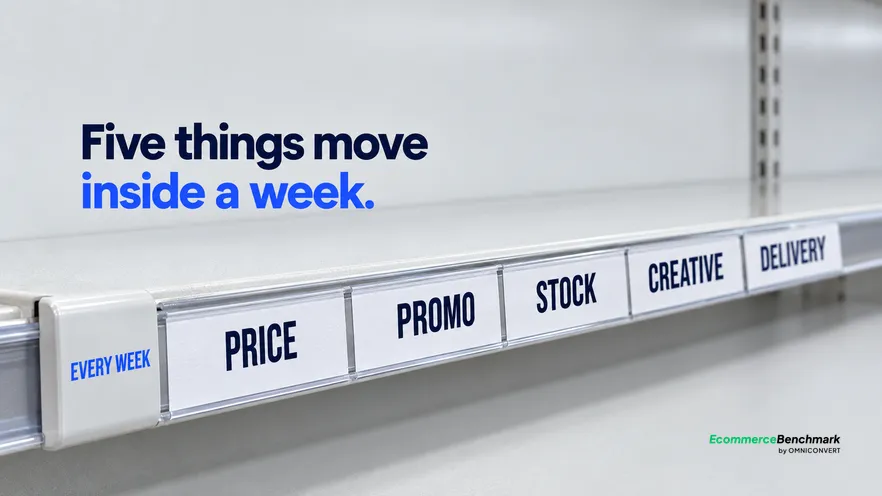
A competitor signal is defined as an observable rival decision that changes often enough to be worth watching on a schedule. The competitor signals worth tracking weekly number exactly five, because only five pass that test: published price on overlapping products, promotional state, stock on their hero lines, genuinely new creative concepts, and the advertised delivery promise. Everything else in competitive research moves on a monthly or quarterly rhythm, and checking it weekly produces a run of unchanged readings that teaches a team the exercise is pointless. Five values for three rivals takes about fifteen minutes, which is the only cadence a weekly habit survives at.
- Five signals move weekly: price, promotion, hero stock, new creative concepts, delivery promise.
- Watching a quarterly signal weekly produces no change readings and kills the habit.
- Count new concepts, not new variants. A variant wave is a testing signal, not a strategy shift.
- A rival out of stock on a hero line is a short opening that only weekly checking catches.
- The weekly log is what lets you tell a clearance from a structural price cut.
Competitor monitoring usually fails on frequency rather than on effort. A brand sets up a weekly review covering positioning, creative, pricing, site changes and review sentiment, runs it diligently for five weeks, records almost no change in four of those five areas, and quietly stops. Nothing was wrong with the list. It was being read at the wrong speed. Last updated: October 2026.
Omniconvert has scored stores against real competitors in their category and country for 13 years in eCommerce, drawing on a CROBenchmark dataset covering 70,000+ experiments and 2,500+ Shopify stores, and the thing that separates monitoring that survives from monitoring that lapses is almost always cadence discipline: each signal checked at the frequency it actually moves. Five signals genuinely move weekly. This is the list, and the reasoning for what is deliberately not on it. For the full four-layer method underneath, see the DTC competitor research stack.
What makes a competitor signal worth tracking weekly
The second property is the one usually missed, and it rules out a surprising amount.
Take a rival's site redesign. It is highly visible, genuinely informative and completely useless at weekly frequency, because you cannot respond to a redesign in a week and it happens once every two years. Reading it weekly costs attention and returns nothing fifty-one weeks out of fifty-two.
Now take a promotion. It changes weekly in most categories, and you can respond inside the week by pulling forward your own offer, adjusting bids, or deliberately doing nothing with a reason. The signal moves at the speed at which you can act, which is what makes it worth the frequency.
There is also a cost nobody accounts for. A monitoring routine that mostly reports no change does not merely waste the time it took. It trains everyone involved to skim it, so when something does move, the report that would have caught it is the one nobody reads carefully any more. A short list that changes is more valuable than a complete list that does not.
The five competitor signals worth tracking weekly
Each one is logged as a number or a short state, not as a paragraph.
1. Published price on overlapping products. For each rival product that competes directly with one of yours, in the same market and currency, record today's published price. This is the highest-value signal on the list because it is unambiguous, fully public, and the input to the most consequential decision you make weekly. The discipline is to log the value even when it has not changed, because the pattern of unchanged weeks is what later tells you whether a cut was a cycle or a structural move.
2. Promotional state. Is a site-wide or category promotion running, what is the mechanic, and is it new this week. Mechanic matters more than depth: a percentage off, a threshold, a bundle and a gift all behave differently and tell you different things about what a rival is defending. A brand that keeps switching to threshold mechanics is usually managing average order value rather than volume.
3. Stock on their hero lines. Check availability on the two or three products a rival is advertising hardest. An out-of-stock hero line is one of the few genuinely time-limited openings in competitive research: it lasts days, it is invisible to anyone checking monthly, and it is the cheapest demand you will acquire all quarter. Shopify's inventory documentation explains why availability states are usually exposed on the product page even when a store would rather hide them.
4. Genuinely new creative concepts. Not new creatives, new concepts. A rival launching fifteen variants of an angle they already ran is testing, which is a process signal. A rival launching a first ad built on a comparison against you, or on a guarantee they have never offered, is a strategy signal, and the two should never be logged in the same column. Count concepts, and keep the count small enough that it means something. The 9 competitor research tools every DTC brand should use piece covers which libraries make that distinction visible.
5. The advertised delivery promise. The delivery window and shipping threshold each rival is currently promoting. This moves more than people expect, because it tracks carrier cost, season and warehouse load rather than strategy, and it is one of the few competitive levers that changes the conversion rate of a page without changing the price on it. The Baymard Institute's checkout research has consistently found delivery cost and timing among the largest drivers of abandonment, which is why a rival quietly shortening a promise is worth a note.
| Signal | Moves | Can you act in a week | Cadence |
|---|---|---|---|
| Published price | Weekly | Yes | Weekly |
| Promotional state | Weekly | Yes | Weekly |
| Hero line stock | Daily | Yes | Weekly |
| New creative concepts | Weekly | Partly | Weekly |
| Advertised delivery promise | Weekly | Yes | Weekly |
| Creative volume and variants | Weekly | No | Monthly |
| Positioning and messaging | Quarterly | No | Quarterly |
| Review and complaint themes | Quarterly | No | Quarterly |
How to read a price move without overreacting to it
This is where the weekly habit actually pays for itself, and it pays in avoided decisions rather than new ones.
A rival drops a competing product by fifteen percent. With no history, the pressure to respond is immediate and the argument is always the same: we are losing share while we debate. With twelve weeks of logged prices, the same event is usually legible within a few days.
If stock on that line has been thinning for two weeks and the cut is deep on specific variants, it is a clearance. It ends, and matching it durably gives away margin against a competitor who was leaving the price point anyway. If the same cut appeared in the same week last quarter, it is a cycle, and the correct response is planned rather than reactive. If it holds flat for six weeks across the range, it is structural, and the real question is whether their cost base supports it and yours does not, which is a strategy conversation rather than a pricing one.
None of those three readings is available from a single observation, which is the entire argument for logging an unchanged value. The log is not a record of events. It is the baseline that makes an event interpretable.
Where the decision needs an experiment rather than an argument to settle it, the wider growth stack carries that: Nexus by Omniconvert unifies commerce data, prioritises experiments by True Profit and generates the campaigns and creative a human approves before they go live. And if you would rather see the whole competitive gap scored rather than assembled by hand, a free leaderboard score benchmarks your store against real competitors in your category and country, with the paid report covering all six dimensions in depth.
FAQ: weekly competitor signals
What is a competitor signal?
A competitor signal is defined as an observable rival decision that changes often enough to be worth watching on a schedule. The test is not whether it is interesting but whether it moves. A signal that changes quarterly, checked weekly, produces twelve readings of no change and trains everyone to stop looking, which is how monitoring programmes quietly die.
Which competitor signals change weekly?
Published price on your overlapping products, promotional state, stock availability on their hero lines, newly launched creative concepts, and the delivery promise they are advertising. All five are published, all five move on a weekly cycle in most categories, and all five are cheap to record. Everything else in competitive research moves slower than that.
How long should a weekly competitor check take?
About fifteen minutes for three rivals, if it is a log rather than an investigation. Record the five values, note anything that moved, and stop. The moment it becomes a discussion about why a rival dropped a price, it has turned into the monthly pass, and a weekly task that takes an hour gets skipped within a month.
Is weekly competitor monitoring worth it for a small brand?
Yes, and it is more valuable for a small brand than a large one, because a small brand can react inside the week. The cost is fifteen minutes and the benefit is noticing a competitor promotion while it is still running rather than reading about its effect in next month numbers. Keep it to one page of values and it stays affordable.
What should you do when a competitor cuts price?
Establish which of three things it is before responding to any of them. A clearance has stock signals behind it and ends. A promotional cycle repeats on a calendar you can learn. A structural cut holds for months and reflects a cost base you may not share. Matching a clearance permanently is the expensive mistake, and the weekly log is what lets you tell them apart.
The bottom line
A weekly competitor routine survives only if it is short enough to be boring. Five signals, three rivals, fifteen minutes, logged as values rather than written up as findings: published price on overlapping products, promotional state and mechanic, stock on their hero lines, genuinely new creative concepts rather than new variants, and the delivery promise they are currently advertising. Log the unchanged weeks, because the unchanged weeks are what make a price move readable as a clearance, a cycle or a structural shift. Everything else in competitive research is real and belongs on a monthly or quarterly pass, and moving it there is what keeps the weekly one alive. To see the whole competitive gap scored across six dimensions rather than assembled by hand, start with a free store benchmark score.