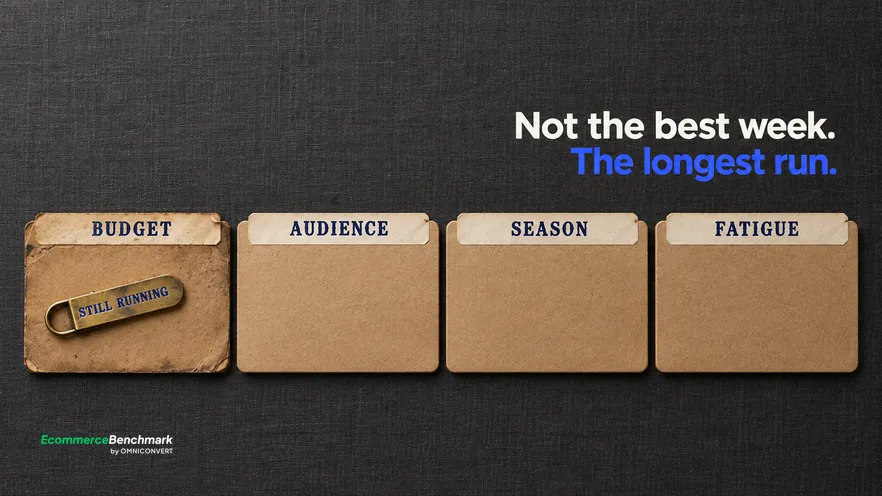
A king ad is defined as the single creative that carries a disproportionate share of an advertising account over a sustained period. The term is practitioner shorthand rather than a platform metric, and the word sustained is doing all the work in it: a creative that wins a test is a winner, while a king ad has held its share through a budget change, an audience change and at least one season. Finding yours is a ranking exercise rather than an analysis one, because the practical signature is continuous days live combined with current spend. The expensive mistake afterwards is copying its appearance instead of isolating why it worked.
- A king ad is sustained share, not a test win. Survival through change is the test.
- Rank by continuous days live and current spend, not by last week return.
- Most accounts have one carrying concept, expressed in several formats.
- Isolate the mechanism before scaling: claim, format, hook or offer.
- A rival long-running ad shows the concept they believe in, never its return.
King ad is not a platform term and does not appear in any ad manager. It is practitioner shorthand, and like most practitioner shorthand it is useful precisely because it names something the official metrics do not: the asset an account is quietly dependent on. Last updated: October 2026.
Omniconvert has measured creative and conversion performance for 13 years in eCommerce, drawing on a CROBenchmark dataset covering 70,000+ experiments and 2,500+ Shopify stores, and the consistent finding about creative concentration is that brands know their best ad exists and routinely identify the wrong one, because they rank on recent efficiency rather than on durability. This piece gives the working definition, the four tests that separate a genuine king ad from a lucky one, the method for finding yours, and what to do with it once you have. For the wider competitive context, see the DTC competitor research stack.
What a king ad is, and what it is not
The distinction worth holding is between efficiency and durability.
An account's cheapest creative in any given week is usually a recently launched one in a narrow audience, and its efficiency is partly an artefact of scale: it has not yet been pushed hard enough to meet its own ceiling. Promote it on that basis and it frequently degrades within a fortnight, which is the single most common creative scaling error.
A king ad is the opposite shape. It has been pushed, it has met a lot of audience, and it is still working. Its efficiency is often unremarkable, and its contribution is large because it holds up at volume. Those are different properties and an account optimised for the first loses the second.
Two further things it is not. It is not the ad with the most impressions, because that is a budget decision and nothing else. And it is not the team's favourite, which matters because the favourite is usually the most crafted asset, and crafted assets tend to express the brand rather than make an argument. The ads that carry accounts are frequently the plain ones that state a claim a buyer actually cared about.
The four tests a genuine king ad passes
Each test eliminates a specific way of being wrong.
The budget test. Did it hold its performance when spend behind it changed materially, in either direction. A creative that only works inside a narrow spend band is an artefact of delivery rather than a strong argument, and it will not survive the quarter you need it most.
The audience test. Did it work on more than one audience definition. This one matters most, because a creative confined to a single warm audience is usually benefiting from existing intent rather than creating any. The claim has to work on somebody who did not already want the product.
The season test. Did it survive a seasonal change. A creative that performs only during a promotional period is an offer that happened to be inside an ad, and when the offer ends the performance ends with it. That is worth knowing and it is not a king ad.
The saturation test. Has it already been through a decline and recovered, or run long enough to have met fatigue and not shown it. Most creative decays with frequency. One that does not, or that recovers after a pause, is carrying a durable argument rather than a novel execution.
Meta's own advertiser documentation on budget and audience structure is worth reading alongside these tests, because several apparent creative effects are structural effects of how delivery allocates budget, and separating the two is the hardest part of this exercise.
| Test | The question | What it rules out | If it fails |
|---|---|---|---|
| Budget | Did it hold when spend changed | A delivery artefact | Keep it narrow, do not scale it |
| Audience | Did it work beyond one audience | Borrowed existing intent | Treat it as a retargeting asset |
| Season | Did it survive the promotion ending | An offer in disguise | Study the offer, not the creative |
| Saturation | Has it met fatigue and held | Novelty rather than argument | Expect decay and plan a successor |
How to find your king ad
The method is deliberately mechanical, and it takes under an hour.
Start by exporting every creative with its launch date and its last active date, and sort by continuous days live. This single view is the one almost nobody looks at, because ad platforms present performance over a selected window and a window shorter than the creative's life hides exactly the property you are looking for.
Then filter. A creative that has been live for a year while receiving almost no budget is not a king ad, it is something nobody got round to switching off. The signature you want is long life plus meaningful current spend, which together mean the asset has survived every review in which somebody could have paused it.
Apply the four tests to what is left, and expect the list to shrink hard. Most accounts find one candidate and a couple of near misses, and the near misses are informative: a creative that passes budget, season and saturation but fails the audience test is a strong retargeting asset being misread as a prospecting one.
Then do the part that actually pays. Isolate the mechanism, because this is where the value is realised and where most teams stop. Ask what the ad is doing: making a specific claim, using a format that suits the product, opening with a hook that earns attention, or carrying an offer that would work in any wrapper. Two or three deliberate tests will usually tell you, and the answer determines what you build next. Variants that hold the mechanism constant and change the surface compound. Variants that reproduce the look while losing the claim are the commonest way a brand spends a quarter failing to replicate its own best asset. For the weekly discipline that catches a rival's long-running creative early, see 5 competitor signals worth tracking weekly, and for the broader frame, competitive intelligence for eCommerce sets out how creative reads alongside offer and conversion.
Where the mechanism question needs an experiment rather than a debate, the wider growth stack carries it: Nexus by Omniconvert unifies commerce data, prioritises experiments by True Profit and generates the campaigns and creative a human approves before they go live.
FAQ: king ads
What is a king ad?
A king ad is defined as the single creative that carries a disproportionate share of an account over a sustained period. It is practitioner shorthand rather than a platform term, and the sustained part is what distinguishes it from a test winner. A creative that wins one week is a winner. One that holds its share through budget changes, audience changes and a season is a king ad.
How do you find your king ad?
Rank your creatives by continuous days live rather than by last-week return, then look at which of the long-lived ones still receive meaningful spend. Longevity plus current budget is the practical signature, because a creative nobody has paused in four months has survived every review somebody could have used to kill it. Then apply the four tests before you build on it.
Can you have more than one king ad?
Rarely more than one per audience and almost never more than one per concept. What looks like several is usually one concept expressed in several formats, which is a healthy position rather than a collection of separate assets. The useful question is how many distinct concepts are carrying the account, and for most brands the honest answer is one.
What should you do once you have found it?
Isolate the mechanism, then vary everything except that. Establish whether the ad works because of its claim, its format, its hook or its offer, which usually takes two or three deliberate tests. Then produce variants that hold the mechanism constant and change the surface, because the common failure is reproducing the look of a king ad while discarding the reason it worked.
Can you spot a competitor king ad?
You can spot a strong candidate, which is most of the value. The platform ad libraries publish start dates, so a rival creative that has been continuously live for months has survived repeated decisions to keep funding it. You cannot see its spend or its return, so treat it as the concept they believe in rather than as a proven performer, and study the claim rather than copying the execution.
The bottom line
The useful thing about the king ad idea is that it points at durability in a discipline that reports almost exclusively on recency. Export every creative with its launch date, sort by continuous days live, and keep the long-lived ones that still carry real budget. Put each survivor through four tests: did it hold through a budget change, did it work on more than one audience, did it survive the promotion ending, and has it met fatigue without collapsing. Expect one candidate rather than five. Then spend your effort isolating whether the claim, the format, the hook or the offer is doing the work, and build variants that keep that constant while changing everything around it. Copying the appearance of your own best ad is the way most brands lose it. To see how your creative dimension scores against real competitors in your category and country, start with a free store benchmark score.