

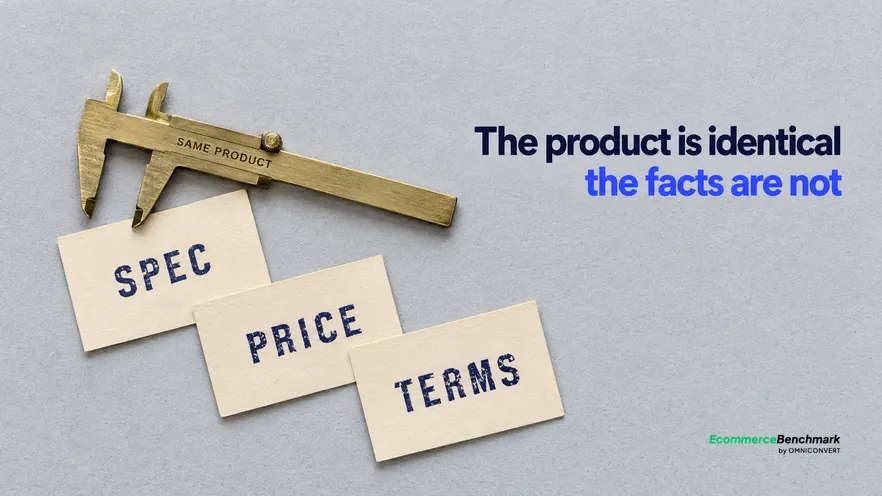
A spec delta is defined as the difference between what two retailers publish about the same manufactured product, covering specification depth, contents of the box, compatibility conditions and warranty terms. To research competitors in consumer electronics is mostly to measure that delta, because the product is identical and the published facts are not. Around 70% of carts are abandoned, frequently where a shopper cannot complete a verification on the page they are on [Baymard Institute, 2025]. This guide covers the five observation layers, how to sample repricing honestly, and which gaps to close first.
- Compare published facts rather than products, because the product is usually identical.
- Include marketplace listings in the competitor set, since they carry the same item.
- Record spec depth, box contents, compatibility and warranty per shared product.
- Sample prices on a fixed schedule, as one snapshot records only the day you looked.
- Read competitor creative for release timing, not for copy ideas.
- Close publishable gaps first, because they cost editing rather than margin.
- Score AI visibility and agentic readiness too, as most competitors measure neither.
Omniconvert has run 70,000+ experiments across 2,500+ Shopify stores over 13 years in eCommerce [CROBenchmark Report 2026, Omniconvert]. In specification-led categories the finding is consistent: retailers selling the same item publish very different amounts about it, and the one that lets a shopper finish their verification wins orders without any price advantage.
Why you research competitors in consumer electronics differently
In most categories competitor research starts with assortment: what are they selling that we are not. Here that question is nearly empty, because a manufactured product is the same object wherever it is listed. The difference is informational and commercial.
That reframes the work usefully. Instead of a difficult judgement about taste or range, you have a comparable, countable set of published facts: which specification values appear, whether the box contents are listed, whether compatibility conditions are stated, who honours the warranty, what the delivery promise resolves to.
It also widens the competitor set in a way teams resist. A marketplace listing of the identical product is a closer competitor than another independent retailer with a different range, and leaving marketplaces out of the analysis produces a tidy report about the wrong contest.
The five observation layers
Work one shared product at a time rather than one competitor at a time. Pick a product several of you sell, list every retailer carrying it including marketplace listings, and fill one row per retailer across the five layers. The pattern is visible after three products.
Publication depth is defined as the number of verifiable facts a retailer states about a product on the page where the purchase decision happens, as distinct from the amount of copy on that page, which is frequently inversely related.
The static four are the ones you can act on immediately. Where a competitor states the standard revision and you do not, that is a gap you close by editing rather than by discounting, and it removes a reason a shopper opened their tab.
| Layer | What it reveals | Collect |
|---|---|---|
| Specification depth | Whether verification can finish there | Once per product |
| Box contents | The most common support question | Once per product |
| Compatibility conditions | Whether they answer the real query | Once per product |
| Warranty and support | Their trust position against yours | Once per retailer |
| Price behaviour | Whether they reprice on a strategy | Weekly, same hour |
| Creative timing | Stock position and discount window | Monthly |
Shopify's merchant guidance has pushed complete and consistent product data across sales channels for years, which is the same argument this table makes from the competitive side [Shopify, 2026]. The cross-category method is in the DTC competitor research stack, and the pricing layer specifically is in how to analyse a competitor's pricing and offers.
Sample repricing on a schedule, not on a whim
This is the layer most often done badly, because it looks like it needs a tool. It does not. Weekly sampling of the same twenty products at the same hour, recorded in a spreadsheet, shows within a month whether a competitor holds price, follows a marketplace, or cuts into a release window.
What you are looking for is not the price. It is the behaviour: how fast they move after a manufacturer change, whether they match a marketplace listing, and whether their cuts cluster before a new model lands. Each of those is a different competitor to compete against.
The way electronics teams waste this research is by acting on a single snapshot. Somebody pulls competitor prices on a Tuesday, finds three products where a rival is lower, and the team drops its own prices to match. The rival was running a two-day promotion, moves back up on Thursday, and the price cut stays because nobody owns reverting it. Six months of that produces a margin position nobody chose, assembled from Tuesdays.
Read their creative for timing, not for copy
Public ad transparency tooling makes this observable without any special access. Meta's Ad Library is designed to let anybody see what a page is currently running [Meta, 2026], and the useful signal in electronics is the timing of the switch rather than the words in the ad.
A competitor still pushing an outgoing model hard has stock to clear and will discount it. One that has already moved its budget to the incoming model has either sold through or written it off. Both tell you something about the window you are about to compete in, and neither requires guessing at their creative strategy.
The methods for this, generalised, are in reverse-engineering competitor ads with the Meta Ad Library and six signals a competitor ad is scaling.
AliveCor used Omniconvert to run a structured A/B testing programme and achieved +21% conversion rate, +5% revenue per visitor, and 94% statistical relevance across their experiments. [Omniconvert, AliveCor case study] That is a testing result rather than a competitor-research result, and the transferable discipline is to turn one observed gap into one experiment rather than shipping a bundle of competitor-inspired changes at once.
Score the two dimensions nobody else is watching
Run the buying questions for your main products through an assistant and record which retailers get named. In specification-led categories the named retailer is usually the one whose compatibility and contents data is readable, which is the same spec delta measured by a different reader.
Agentic readiness is the same facts again, read by an automated buyer. A listing that cannot state availability for the exact variant, the payable price and the return window is skipped, and almost nobody in this category has checked whether theirs can.
Those two sit alongside creative, reviews, competitor synthesis and CRO in the six dimensions the free benchmark score measures, and they are the two where a lead is still cheap to take. The definitions are in what agentic commerce readiness is and AI visibility for Shopify stores.
What to do this week
- Pick three shared products. List every retailer carrying them, marketplace listings included.
- Fill the static four layers. Spec depth, box contents, compatibility, warranty. One row per retailer.
- Start the weekly price sample. Twenty products, same hour, a spreadsheet. Do not act for a month.
- Run your buying questions through an assistant. Record who gets named and what their page states that yours does not.
Then close the publishable gaps and leave the commercial ones for a decision with a number attached. Where a benchmark gap turns into a testing programme, Omniconvert Explore is the CRO platform for proving each change with A/B and multivariate testing, segmentation and session recordings. Once you know where your store ranks, Omniconvert Commander (formerly Nexus) identifies which metrics to prioritise and queues the experiments most likely to close the gap, and you approve what goes live. For the tactical fixes a competitor comparison usually surfaces, how to prioritise fixes when you are below benchmark covers the ranking.
Frequently asked questions
How do you research competitors in consumer electronics?
By comparing what each retailer publishes about the same manufactured product rather than comparing the products. Specification depth, contents of the box, compatibility conditions and warranty terms differ widely between retailers selling an identical item, and those differences decide the sale more often than price alone.
Who counts as a competitor here?
Anybody appearing for your products, which almost always includes marketplace listings of the identical item. A marketplace listing competes with you more directly than another independent retailer does, because the buyer sees the same product at a different price with different stated terms.
What is a spec delta?
The difference between what two retailers publish about the same item. One lists the standard revision, the included cable and the warranty holder; the other lists a marketing paragraph. The product is identical and the shopper can only complete their verification on one of the two pages.
How often should I sample competitor prices?
On a fixed schedule rather than when you remember. A competitor that reprices daily is running a strategy, and a single snapshot tells you only about the day you looked. Weekly sampling on the same products at the same hour is enough to see the pattern without building a system.
What does competitor advertising reveal in this category?
Stock position and timing. When a competitor shifts creative from an outgoing model to an incoming one, they are telling you where their inventory sits and roughly when the discounting on the old line will start, which is more actionable than the creative itself.
What should I act on first?
The gaps you can close by publishing a fact. Where a competitor states the standard revision, the box contents or the warranty holder and you do not, closing that costs an afternoon of editing and removes a reason a shopper left. Commercial gaps come after, because they cost money.
Measure the delta, not the product
Take three products you share with your competitors, list every retailer carrying them including the marketplace listings, and record four published facts for each: specification depth, box contents, compatibility conditions and who honours the warranty. The table takes an afternoon and it will show you several places where a rival lets a shopper finish a check that your page leaves open.
Close those by editing, start a weekly price sample and do not act on it for a month, and run your own buying questions through an assistant to see who gets named. The product is identical. Everything you are competing on is a published fact, and most of them are free to fix.