Last updated: October 2026 · By The Ecommerce Benchmark Team
Working out why an ad is winning means identifying which part of it is carrying the performance, which is a much harder question than noticing that it has run for four months. Most competitor analysis stops at the easy half and then copies the wrong thing: the edit, the colour grade, the voiceover style, none of which is usually what made the ad work. Omniconvert has measured creative performance across 70,000+ experiments and 2,500+ Shopify stores over 13 years in eCommerce, and the single most common cause of a disappointing creative test is a confident diagnosis that named the wrong layer. This guide sets out the Five-Layer Teardown, the Substitution Test that isolates the load-bearing element, and how to turn a diagnosis into something you can actually prove.
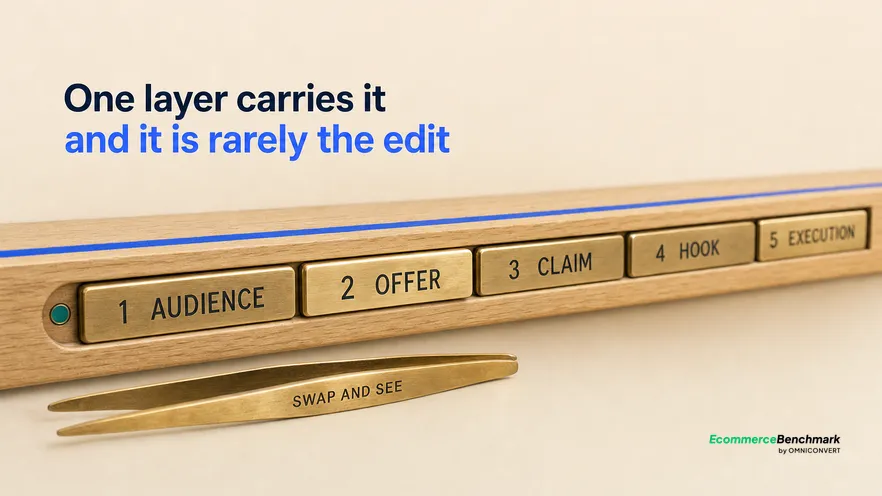
Reverse-engineering an ad is defined as identifying which of its layers is responsible for its performance, rather than describing what the ad contains. Decompose it into five layers, audience, offer, claim, hook and execution, then run the Substitution Test on each: imagine that element replaced by a generic version and ask whether the ad still works. The layer whose removal collapses it is the one carrying the win. Execution is the layer teams examine first and the one that transfers least, which is why so many copied ads underperform.
- Five layers carry an ad: audience, offer, claim, hook and execution. Only one is usually doing the heavy lifting.
- The Substitution Test isolates it: swap each layer for a generic version and see which swap kills the ad.
- Offer wins masquerade as creative wins constantly, and copying the creative without the offer produces a false negative.
- The objection an ad answers is the most transferable element. The artwork is the least.
- Write the diagnosis as a hypothesis that could fail, then run the test that would fail it.
Why descriptions are not diagnoses
A typical competitor teardown reads like an inventory: fast cuts, user-generated feel, text overlay in the first second, product reveal at four seconds, discount in the last frame. Every observation true, and none of them an explanation.
The question a diagnosis has to answer is counterfactual. If this ad had been shot in a studio instead of on a phone, would it still work? If it had opened with a product shot instead of a complaint, would it still work? If the offer had been ten percent off instead of a bundle, would it still work? Only one or two of those swaps will plausibly break it, and those are the answer.
This matters commercially because creative production is the expensive part. A team that diagnoses correctly can test the mechanism cheaply in its own brand language. A team that diagnoses wrongly spends a production budget reproducing a look and concludes the angle does not work in their category.
The Five-Layer Teardown
Each layer answers a different question, and each is inferable from outside with varying confidence.
- Audience. Who is this for? Inferred from vocabulary, assumed category knowledge, the objection opened with, the price implied and the context shown. Confidence is moderate and usually sufficient.
- Offer. What is being proposed? Bundle, trial, subscription, guarantee, straight discount, or nothing at all. This is fully visible and frequently the real answer.
- Claim. What is asserted, and which worry does it settle? The claim is the argument of the ad, stripped of its delivery.
- Hook. What happens in the first two or three seconds, and why does it stop a scroll? Hooks are a small set of recurring structures rather than infinite inventions.
- Execution. Format, pacing, voice, casting, grade, music. Highly visible, highly expensive to copy, and rarely the mechanism.
Writing one sentence per layer takes a few minutes per ad and immediately exposes the gap in most teardowns, which is that layers one to three were never considered at all.
How to reverse-engineer why an ad is winning, layer by layer
The test is deliberately crude because precision is unavailable from outside. What it provides is a ranking, and a ranking is enough to decide what to build.
Work through it in order. Replace the specific audience signals with generic ones: does the ad still have a reason to exist? Replace the offer with a plain ten percent discount: is it still compelling? Replace the claim with a generic quality statement: is there anything left? Replace the hook with a product shot: would you still stop? Replace the execution with a competent studio version: does it lose its force?
In most cases exactly one substitution causes a visible collapse. That is the load-bearing layer. Occasionally two interact, typically a claim and the offer that makes it credible, and that pairing is itself the finding: the angle only works when both are present, which is important to know before you test the claim alone.
The public libraries make this easier than it sounds, because they show you the advertiser's variant set. Google's Ads Transparency Center and Meta's equivalent let you see several creatives from one advertiser side by side, and the element they hold constant across variants is the element they believe is doing the work. That is the advertiser's own diagnosis, revealed by their behaviour rather than stated.
Offer wins dressed as creative wins
This is the single most expensive misdiagnosis in competitor creative work, and it is common because offers are easy to see and easy to discount mentally as a detail.
Consider what an unusual offer does to an ad. A long guarantee removes risk, so the creative no longer has to overcome scepticism and can spend its seconds on desire instead. A bundle changes the comparison set, so the price objection never arises. A trial converts a purchase decision into a much smaller one. In each case the offer has already done the persuasive work, and the creative is just announcing it well.
So before briefing anything, ask whether your business would match the offer. If the answer is no, the ad is not a template for you regardless of how good it looks, and the useful finding is about your pricing rather than your creative. If the answer is yes, test the offer first and the creative second, because the offer is the larger variable.
What transfers, and what does not
The table sets out the five layers against how reliably each one moves between brands, and what typically goes wrong when a team copies that layer directly.
| Layer | Transfers between brands? | The usual failure when copied directly |
|---|---|---|
| Objection answered | Strongly, within a category | Rarely fails; the main risk is answering an objection you do not actually have |
| Hook structure | Well, if rewritten in your own language | Copied word for word it reads as borrowed and dates quickly |
| Offer shape | Well, if your margins allow it | Copied without the margin behind it, it wins volume and loses money |
| Claim | Only if you can substantiate it | An unsupportable claim is a compliance problem, not a creative one |
| Audience framing | Partly; depends on overlap with your buyer | Right argument aimed at a buyer who was never yours |
| Execution and production style | Poorly | Most of the budget, least of the effect, and it looks derivative |
The bottom row is where most competitor-inspired creative budgets go, and the top row is where the return is. That inversion is worth putting in front of whoever signs off production spend.
Turning a diagnosis into a test
The discipline here is to stop testing competitor ads and start testing competitor hypotheses. A test that pits a copy of their creative against your current creative tells you almost nothing, because the two differ on every layer at once.
A clean test holds your brand, format and production constant and varies only the diagnosed layer. If the diagnosis is the sizing objection, both arms are your creative, in your voice, and one addresses sizing while the other addresses something else. A result from that test is directly actionable and remains true after the competitor pulls their ad.
This is also where the landing step has to be checked, because an ad test with a mismatched destination measures the wrong thing. Baymard Institute's ecommerce usability research documents how reliably a product page loses a visitor by failing to answer the question that brought them, and an ad that raises a specific objection should land on a page that resolves it within the first screen. Shopify merchants in particular should check the mobile rendering of that page before the spend starts, since that is where most of the traffic will arrive.
What a performance marketer should do this week
- Pick a single long-running competitor creative. One, not a folder.
- Write one sentence per layer: audience, offer, claim, hook, execution.
- Substitute each layer with a generic version and note which swap collapses the ad.
- Check explicitly whether the offer is carrying it, and whether your margin could match it.
- Look at the advertiser's variant set: whatever they hold constant is their own diagnosis.
- Write the hypothesis in one sentence, then design the two-arm test that would disprove it.
Creative diagnosis only pays if the traffic lands somewhere that converts. The free Ecommerce Benchmark leaderboard score rates a store across six dimensions, Creative and Ads, Reviews and UGC, AI Visibility, Agentic Commerce, Competitor Synthesis and CRO, benchmarked against real competitors in your category and country, with the paid audit report returning the full prioritised detail. For the page-side half of the problem, the CRO audit checklist covers the destination. And where a team wants the creative hypotheses ranked and generated continuously rather than one teardown at a time, Nexus by Omniconvert is the AI for eCommerce growth engine that unifies commerce data, prioritises experiments by True Profit and produces the creative you approve before it goes live.
Frequently asked questions
How do you work out why a competitor ad is working?
Break it into five layers and test each one for whether the ad would survive without it. The layers are the audience it is aimed at, the offer it carries, the claim it makes, the hook in the first seconds, and the execution. Most teams look only at execution, which is the layer that transfers least. Run the Substitution Test on each layer in turn, imagining the ad with that element swapped for a generic version, and the layer whose removal kills it is the one carrying the performance.
What is the difference between a creative win and an offer win?
A creative win survives a change of offer; an offer win does not. If you imagine the same ad with a standard discount instead of its unusual one and it still looks compelling, the creative is doing the work. If it collapses into an ordinary ad, you are looking at a pricing decision wearing a creative costume. This distinction matters enormously, because copying the creative without the offer reliably produces a disappointing test and a wrong conclusion about the angle.
Can you tell who an ad is targeting from outside?
Not precisely, but you can infer a great deal from the creative itself. The vocabulary, the objection it opens with, the context shown, the price point implied and the level of category knowledge assumed all narrow the audience considerably. An ad that opens by explaining what a category is addresses a newcomer; one that opens with a comparison against a named alternative addresses someone already shopping. That inference is usually enough to decide whether the angle is relevant to your buyer.
What is the most transferable part of a winning ad?
The objection it answers, followed by the hook structure. The specific visual, voice and edit are the least transferable, because they are tied to a brand and a production budget. If a competitor creative is winning by addressing a worry about sizing, durability or delivery, that worry exists in your category too and your version can answer it in your own voice. Copy the argument, not the artwork, and the test tells you something you can use.
How do you confirm your diagnosis is right?
Write the diagnosis as a testable hypothesis before you build anything, then run one test that would fail if you were wrong. If you believe the win is carried by the sizing objection, build two variants: your normal creative answering the sizing objection, and your normal creative answering something else. If the first outperforms, the diagnosis holds independently of the competitor execution. A diagnosis never tested is just a confident opinion about another company advertisement.
With the load-bearing layer named, the next step is to turn a competitor's winning ad into your own without reproducing its expression.
The bottom line
Noticing that an ad has run for months is observation; naming the layer that keeps it running is analysis, and only the second one changes what you build. Decompose every creative into audience, offer, claim, hook and execution, then substitute each layer with a generic version and watch for the swap that collapses it. Check the offer explicitly, because offer wins impersonate creative wins more often than anything else and copying the artwork without the pricing produces a false negative you will act on for a year. Then write the diagnosis as a hypothesis that could fail, and run the two-arm test in your own brand language that would fail it.