

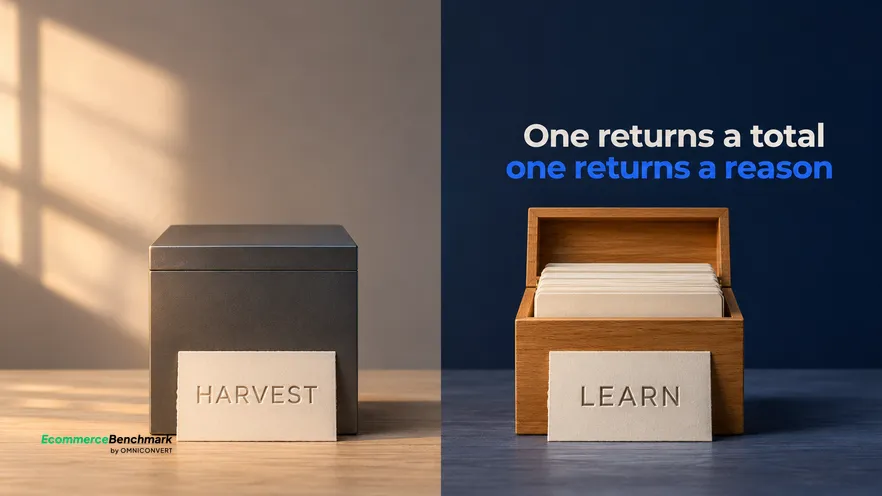
Diagnosability is defined as the property of a campaign that a result can be traced back to a decision somebody made, which is what makes the result transferable to the next campaign. Advantage+ vs manual campaigns is a trade in exactly that: an automated shell harvests demand efficiently and reports a total, while a manual structure costs more attention and returns findings you can reuse. Around 70% of carts are abandoned on average, so the conversion events either approach learns from are scarcer than traffic suggests [Baymard Institute, 2025]. This comparison covers which job each one is for, how to run both without contaminating either, and the honest reason to stay manual.
- Treat an automated shell as a harvesting tool, not as a research tool.
- Keep a funded manual lane whenever you still have questions worth reusing answers to.
- Give the two separate budgets and separate jobs, never the same objective at equal weight.
- Fund one learning question properly instead of four that never conclude.
- Expect automation to raise the creative requirement, because it selects among your supply.
- Judge both on contribution after delivery and returns, not on reported in-platform return.
Omniconvert has measured store performance across the CROBenchmark dataset of 7,000+ websites in 15+ industries, against 248+ audit criteria, over 13 years in eCommerce [CROBenchmark Report 2026, Omniconvert]. The pattern that bears on this choice is how quickly an account stops accumulating transferable knowledge once everything in it is automated. Performance can hold for a year while the team's ability to explain it quietly disappears.
Advantage+ vs manual campaigns: the real trade
Start by setting aside the control argument, because it is mostly sentimental. Manual control means the ability to make audience and placement decisions by hand, and the honest record of hand-made decisions against automated ones is not flattering. If control were the only question, this would have stopped being a debate.
The question that survives is what you know afterwards. A manual campaign that works tells you that a particular argument reached a particular audience in a particular placement. That sentence transfers: into next quarter's brief, into the retention programme, into the product page. An automated campaign that works tells you the total was good.
So the two are not rival ways of doing one job. They are two jobs. One converts demand you have already understood; the other produces the understanding. Accounts in trouble have usually stopped doing the second and not noticed, because the first was still working. What makes a concept worth supplying either lane is in hook, angle, CTA, and the campaign-structure decision that sits beside this one is ABO vs CBO.
| Dimension | Automated shell | Manual structure |
|---|---|---|
| Main job | Harvest known demand | Produce reusable findings |
| What a win tells you | The total was good | Which decision worked |
| Operator attention | Low | High |
| Creative requirement | Higher | Moderate |
| Use in a new market | Weak | Core strength |
| Signal efficiency | Concentrated | Divided by design |
| Risk over a year | Knowledge decays | Effort cost compounds |
Run both, with separate budgets and separate questions
The arrangement that works is boring and durable. Most of the money sits in the automated lane, doing the harvesting. A smaller, deliberately protected budget sits in a manual lane answering one question at a time, with its own objective where possible so the two are not drawing from the same pool.
Meta's own campaign guidance has consistently pointed toward consolidation for learning efficiency [Meta, 2026], and that argument applies inside each lane rather than across them. Consolidate the harvest. Keep the learning lane small, separate and finished.
The word finished matters. A learning budget spread across four simultaneous questions produces four results that each arrive too late and too wide to act on, which is the appearance of experimentation without the benefit. One question funded to a readable conclusion is worth more than four that never conclude. The bidding question underneath both lanes is covered in manual bidding vs cost caps vs bid caps, and the audience question is in broad targeting vs interest stacks in 2026.
The way growth teams get this wrong is by cancelling the learning lane in a good quarter. The automated campaigns are performing, the manual lane looks like overhead producing no revenue, and somebody reasonably moves its budget to where the return is. Eighteen months later the team cannot explain why anything works, cannot brief a new market, and has no record of which arguments ever landed. Nothing broke on the way there, which is what makes it hard to catch: the account was healthy throughout and the institutional memory was being spent.
Automation raises the creative requirement
This is the part most teams underestimate when they move budget into an automated shell. The work does not disappear; it moves upstream, from the campaign panel to the studio. A shell fed a thin, homogeneous set of assets has very little to choose between and performs accordingly.
Concept distinctness is defined as the degree to which two ads make genuinely different arguments rather than restating one argument with different photography, and it is the input automation consumes fastest. Crops, colourways and aspect ratios of a single idea are one idea.
Where this sits against the rest of your category is worth measuring rather than assuming. A free leaderboard score benchmarks your store against real competitors in your category and country across six dimensions: Creative and Ads, Reviews and UGC, AI Visibility, Agentic Commerce, Competitor Synthesis and CRO. AI Visibility and Agentic Commerce are the two nobody else scores at all. For what rivals are actually running, start with Meta's own Ad Library.
AliveCor used Omniconvert to run a structured A/B testing programme and achieved +21% conversion rate, +5% revenue per visitor, and 94% statistical relevance across their experiments. [Omniconvert, AliveCor case study] That is an on-site testing result rather than a paid-media one, and the transferable discipline is that the value sat in a structured programme producing readable answers, which is precisely the job the manual lane is funded to do.
The honest reason to stay manual
Put the test as a question about your own position rather than about the tooling. Did you learn anything in the last quarter that changed a brief? If yes, the learning lane is earning its budget. If no, either the questions have genuinely run out, which happens, or the lane has quietly become a smaller copy of the harvest.
When the answers do stop changing, harvesting is the better use of the money and holding a manual structure out of habit is just an attention tax. The judgement is about whether your understanding is still moving, and it should be revisited roughly when you would revisit any other strategic assumption rather than monthly.
Downstream of either lane sits the question of whether the order was worth winning. Omniconvert Commander (formerly Nexus) is an AI for eCommerce growth engine that unifies commerce data, prioritises experiments by True Profit, and generates campaigns and creative you approve before they go live, which is the layer that tells you whether reported return and contribution agree.
Frequently asked questions
When does an automated campaign beat a manual one?
When you want volume from a position you already understand. An automated shell is a harvesting tool: it is efficient at converting demand you have already learned how to address. It is a poor instrument for finding out something new, because it does not report which of its own decisions produced the result.
What do you actually give up?
Diagnosability, not control. Control is overrated and mostly means the ability to make worse decisions slowly. What matters is that a manual campaign tells you which audience, placement and creative produced a result, so the finding transfers. An automated campaign tells you the total, which does not.
Should both run in the same account?
Yes, with separate budgets and separate jobs. The automated campaign carries the volume and the manual campaigns carry the questions. What does not work is running them as rivals on the same objective at the same weight, because they compete for the same inventory and the comparison then describes the budget split.
How much budget should the learning side get?
Enough to reach a readable result on one question at a time, which is usually a small but non-trivial share. The failure mode is a learning budget so thin that no test ever concludes, which produces the appearance of experimentation and none of the benefit. One question funded properly beats four underfunded.
Does an automated campaign remove the need for creative work?
It increases it. The system selects among what you supply, so the quality and the distinctness of the supply become the main lever you still hold. An automated campaign fed three variations of one concept is an automated campaign with one idea in it.
What is the honest reason to stay manual?
That you still have things to find out. A team entering a new market, launching an unfamiliar category or rebuilding after a strategy change needs answers it can reuse, and those only come from campaigns whose structure it set deliberately. Once the answers stop changing, harvesting is the better use of the money.
Ask what you learned last quarter
Look back over the last three months and find one thing you learned from paid media that changed a brief, a product page or a retention flow. Write it down. If you can, your learning lane is doing its job and should keep its budget whatever the comparison against the harvest looks like.
If you cannot, you have a choice to make deliberately rather than by drift. Either the questions have run out, in which case move the money to the harvest and say so out loud, or the lane has been underfunded into uselessness and needs one properly funded question instead of several thin ones. Both are reasonable. Discovering in a year that nobody can explain the account is not.