

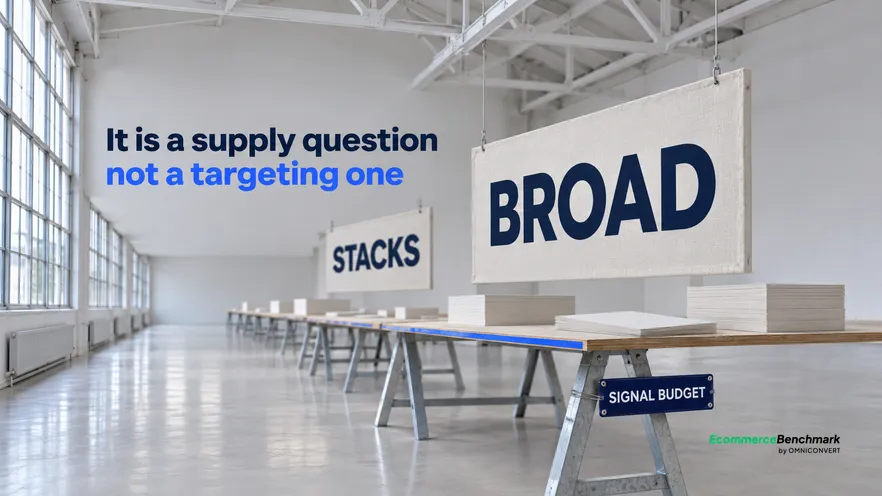
A signal budget is defined as the number of conversion events an account can supply per week divided across its active audience segments, which sets how finely that account can usefully be segmented. Broad targeting vs interest stacks is therefore a question about supply rather than about audience precision: broad asks the platform to find the audience from the creative, and it needs both enough creative and enough weekly conversions to do it. Around 70% of carts are abandoned on average, so the conversion events any account has to learn from are scarcer than its traffic suggests [Baymard Institute, 2025]. This comparison covers which account conditions favour each structure and how to test one against the other without contaminating both.
- Treat the choice as a creative-supply question, not an audience-precision question.
- Divide your weekly conversions by your active segments before you add another stack.
- Choose broad when you can ship several genuinely distinct concepts a month.
- Choose stacks for a niche the platform cannot infer, or a launch with no history.
- Never run the two against each other in one account at the same time.
- Expect a weak creative to fail faster under broad, because nothing shelters it.
- Judge the test on contribution after delivery cost, not on in-platform return.
Omniconvert has measured store performance across the CROBenchmark dataset of 7,000+ websites in 15+ industries, against 248+ audit criteria, over 13 years in eCommerce [CROBenchmark Report 2026, Omniconvert]. The relevant pattern for this comparison is that the accounts which struggle with broad targeting are rarely the ones with the wrong audience theory. They are the ones that cannot produce enough distinct creative to give the platform anything to choose between.
Broad targeting vs interest stacks: what actually differs now
The argument used to be about whether a platform could find buyers as well as a media planner could describe them. That resolved in a way that moved the constraint rather than removing it: delegating selection works, and the price is that the system needs material to select with. A broad campaign with two creatives is not broad targeting, it is an untargeted campaign with two options.
Interest stacks invert the trade. You supply the theory about who buys and the platform supplies less of the work, which means a single strong creative can carry a campaign. The cost arrives in the denominator, which is the subject of the next section. The anatomy of what makes a concept distinct in the first place is in hook, angle, CTA.
The signal budget decides how finely you can segment
This arithmetic settles most of these arguments and is almost never done before the structure is chosen. An account producing a modest number of weekly purchases, split across six stacks, has given each one a fraction of an already small number. Each then optimises slowly, reacts late and looks volatile, and the volatility gets read as audience quality.
Meta's own campaign-budget guidance has pointed in this direction for years, which is that consolidation helps learning and fragmentation hurts it [Meta, 2026]. The structural version of that argument, at the campaign rather than the audience level, is in ABO vs CBO.
Creative distinctness is defined as the degree to which two ads make genuinely different arguments rather than restating one argument with different photography, and it is the supply-side variable broad targeting consumes. Six colourways of one concept is one concept.
| Dimension | Broad targeting | Interest stacks |
|---|---|---|
| Who selects the audience | The platform | You do |
| Main input it consumes | Distinct creative | Audience theory |
| Signal per segment | Concentrated | Divided |
| Minimum creative supply | High | Low |
| Weak creative | Fails fast | Partly sheltered |
| Niche the platform cannot infer | Struggles | Core strength |
| Reporting clarity | Creative is the test | Audience is the test |
The way growth teams get this wrong is by migrating to broad targeting and keeping the creative calendar. The structure changes on a Monday, the account now wants eight concepts a month, and the studio is still producing two concepts and six crops of each. Performance drops, the team concludes broad does not work for their category, and reverts. The targeting was never tested: a creative pipeline was, against a structure needing three times its output.
When interest stacks are still the right answer
The first is the strongest. Some products serve an audience defined by something that never shows up in platform behaviour: a professional qualification, equipment they already own, a regulatory context. The platform cannot infer what it cannot observe, so a stack built from a real list is not a worse version of broad, it is the only version available.
The second is temporary and worth planning for. A new account with no conversion history has nothing for a broad campaign to learn from, so the early weeks are expensive exploration. A stack narrows the search while signal accumulates, and the discipline is to set the switching condition in advance.
The third is not a performance decision and should not be judged as one. A regional launch or a retail partnership commitment means reaching a specified audience, and broad delivery will not honour that constraint. eMarketer has tracked how much retail media planning now sits alongside performance buying rather than inside it [eMarketer, 2025].
How to test one against the other without contaminating both
This is where most comparisons of these two structures go wrong, and it is not a subtle error. Two structures bidding for overlapping inventory with a shared conversion signal degrade each other, and the account-level number shows whichever one the budget favoured. A clean test gives the challenger a fixed separate budget, a window long enough to clear learning inside one seasonal regime, and judges it on contribution after delivery and discount rather than on in-platform return.
Where this is judged against the rest of your category, a free leaderboard score sets the baseline. Your store is benchmarked against real competitors in your category and country across six dimensions: Creative and Ads, Reviews and UGC, AI Visibility, Agentic Commerce, Competitor Synthesis and CRO. AI Visibility and Agentic Commerce are the two competitors do not measure at all. For what rivals are actually running, start with Meta's own Ad Library.
AliveCor used Omniconvert to run a structured A/B testing programme and achieved +21% conversion rate, +5% revenue per visitor, and 94% statistical relevance across their experiments. [Omniconvert, AliveCor case study] That is an on-site testing result rather than a paid-media one, and the transferable discipline is the statistical relevance: a structure test that has not cleared learning inside a single regime is not a result, whichever way it points.
What to decide this week
- Calculate your signal budget. Weekly conversions divided by active segments. Write the number down.
- Count genuinely distinct concepts. Per month, honestly. Crops and colourways do not count as separate concepts.
- Decide whether your audience is inferable. If the platform cannot observe what defines your buyer, stacks are doing real work.
- Commit to one structure. Then test the other in a contained window with its own budget. Not both at once.
Downstream of the structure sits the question of what the change was worth. Omniconvert Commander (formerly Nexus) is an AI for eCommerce growth engine that unifies commerce data, prioritises experiments by True Profit, and generates campaigns and creative you approve before they go live, which is the layer that tells you whether a structure change improved contribution or only improved reported return.
Frequently asked questions
Is broad targeting better than interest stacks in 2026?
For most accounts, yes, and not because the targeting is cleverer. Broad targeting asks the platform to find the audience from the creative, which works when you can supply enough distinct creative and enough weekly conversions for it to learn from. Interest stacks earn their place when you have neither.
What is a signal budget?
The number of conversion events your account produces per week, divided across its active segments. It is the figure that decides how finely you can segment: split a modest signal budget across six interest stacks and each one learns slowly, which is the most common cause of a stack underperforming a broad campaign.
When do interest stacks still win?
When the product serves a niche the platform cannot infer from behaviour, when you are launching with no conversion history at all, or when a specific audience has to be reached for a reason outside performance, such as a retail partnership or a regional launch. In those cases the stack is doing a job broad cannot.
Does broad targeting make creative testing harder?
It changes what you are testing. With broad targeting the creative is the targeting, so a creative test is an audience test and the two cannot be separated. That is cleaner in one sense and it means a weak creative is no longer rescued by a tight audience, which is why creative supply becomes the binding constraint.
Can you run both at once?
You can, and the usual failure is running them against each other in the same account at the same time. They compete for the same inventory and the same signal, so the comparison is contaminated. Run one as the main structure and hold the other as a contained test with its own budget and its own window.
What decides the answer for a specific account?
Three things: weekly conversion volume, how many genuinely distinct creative concepts you can ship per month, and whether your product serves an audience the platform can infer. Two out of three pointing at broad is enough. If all three point at stacks, you have a creative supply problem to solve rather than a targeting one.
Count the concepts first
Before changing a single campaign, count how many genuinely distinct creative concepts your team shipped in the last three months. Not assets, concepts: different arguments, aimed at different reasons to buy. Then divide last week's conversions by the number of segments currently running.
Those two numbers answer the question better than any case study will. A team shipping several distinct concepts a month, with conversions to spare, should delegate selection to the platform. A team shipping one concept a quarter will get a worse result from broad and conclude the wrong thing about why.